A Ph.D. candidate at the Leiden Institute of Physics has developed the most vibration-free cryogenic scanning tunneling microscope in the world. The new microscope could shed light on unconventional superconductivity.
A scanning tunneling microscope (STM) is extremely delicate. A measuring needle with an atomically sharp apex is positioned just a few angstroms away from a sample. This is roughly the diameter of an atom, so the vibrations between the needle and the sample have to be extremely small. As a reference, the tip of Mount Everest would be allowed to vibrate less than the size of a bacterium. Additionally, the goal was to make a cryogenic microscope with a temperature around 4 Kelvin – almost absolute zero. These ultra-low temperatures are needed for spectroscopic visualization of the electronic properties of materials down to the atomic scale. “This greatly complicates things, as the mechanics of regular STMs are not suited for such low temperatures,” explains Irene Battisti, the instrument’s developer. Therefore, she worked with sapphire. “This material is not only expensive, but its toughness also makes it very difficult to process,” she says.
The Ultramicroscopy Hall in the Gorlaeus Building has been designed to isolate vibration. According to the architect, it is one of the most vibration-free places in the world. This is achieved by a separate foundation, on which a concrete ‘island’ of 30 tons is suspended through springs, topped with a lead-filled table located on a second set of springs. Combined with the unique design of the microscope, the system creates the most stable cryogenic STM in the world.
But why hasn’t this been done before? “Only recently has technology developed enough to build this microscope. But more importantly, the Fine Mechanical Department (FMD) in Leiden has crucial know-how and skills, which are quite unique in the world.” Battisti worked closely together with Kees van Oosten and Gijsbert Verdoes from the FMD.
The group of Milan Allan, of which Battisti is part, studies quantum materials, including high-temperature superconductors. “Normally, materials become superconducting below 4 Kelvin,” Battisti explains. “This requires liquid helium for cooling, which is very expensive. But some materials become superconducting at 100-150 Kelvin, which only requires easily accessible liquid nitrogen.”
However, how these high-temperature superconductors work remains a mystery, making it difficult to actually apply them practically. “Since I started my Ph.D., we have been working hard to understand this mystery, together with our colleagues from the Lorentz Institute. With this new STM, I hope to add some important pieces to the puzzle. We know that waves can interfere with each other,” says Battisti. “And by studying the interference pattern of waves, we can get to know something about the wavelength or the wave property. From quantum mechanics, we know that we can see electrons as particles, but also as waves—the wave-particle duality. The experiments that we want to conduct are looking at the wave-like features of electrons. And with our new STM, we can visualize the interference between these electron waves on the surface of the material. From these patterns, we can then extract properties of the electrons itself, and thereby properties of the material.”
************
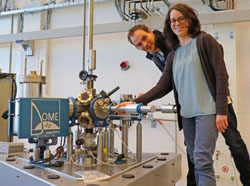
Image – Irene Battisti Kees van Oosten with the STM. Courtesy of Leiden University/Bryce Benda.
For more information:
leiden.edu