Engine crankshafts are machined and hardened to provide necessary machinability, strength, fatigue, and wear properties after forging and direct heat treatment. Selection of an appropriate steel grade is very important in the fabrication of crankshafts.
Processing methods such as induction hardening, nitrocarburizing, and fillet rolling require the selection of steel grades optimally fit for specified applications. Various steel grades have been developed and used for a wide range of automobile engines.
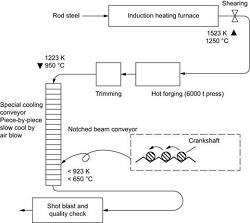
Fatigue strength, machinability, and work-hardening properties were investigated, and strengthening of the ferrite grain was performed by additions of vanadium. An addition of 0.25% V was effective for selective strengthening of the ferrite phase where fatigue cracks initiate, and these crankshafts were conformed. These crankshafts are hot forged after induction heating and directly control cooled on a notched beam conveyor or hanger conveyor to produce a tensile strength of 850 MPa (123.3 ksi).
For more information, click on the link below (subscription required). Then scroll to Figure 25.
H. Tahira, K. Funatani, Forge and Direct Heat Treatment Processes and Technologies, Heat Treating of Irons and Steels, Vol 4D, ASM Handbook, Edited By Jon L. Dossett, George E. Totten, ASM International, 2014, p 241-252, https://doi.org/10.31399/asm.hb.v04d.a0005994