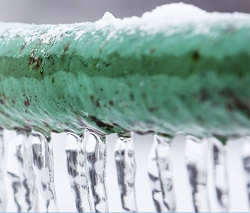
Materials scientists at the UCLA Samueli School of Engineering and colleagues in China announce that they have developed a hydrogel coating that prevents ice from forming until the temperature is very low. The researchers tested the coating on several materials, including plastic, glass, ceramics, and metals. It set a record by preventing ice from forming until the temperature reached 31 degrees below zero Celsius (or 23.8 degrees below zero Fahrenheit). The previous record of 28 degrees below zero Celsius (18.4 degrees below zero Fahrenheit) was established in 2016 when a different coating was applied to silicon and glass.
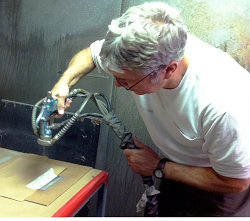
When sprayed onto a surface, the hydrogel forms a thin, transparent coat that helps prevent freezing in three different ways: lowering the freezing temperature of water on the surface, delaying ice crystals from growing, and making the surface difficult for ice to stick to.
The gel is made mostly of water, but its key ingredient is polydimethylsiloxane, a nontoxic, silicone-based polymer used in contact lenses, cosmetics, lubricants, and other applications that require some slipperiness. The way it works is inspired by a natural mechanism that keeps blood from freezing in several species of fish that live near Antarctica.
The hydrogel also set a record for the amount of time it delayed ice from forming at a temperature of 25 degrees below zero Celsius (13 degrees below zero Fahrenheit). In the study, materials including plastic, glass, ceramics, and metals that were coated with the hydrogel took more than 65 minutes for ice to form at that temperature, more than 40 minutes longer than the previous record, which also was set during the 2016 study.
And even if ice does form on an object’s surface, the hydrogel coating makes it easy to remove the ice by simply brushing or blowing it off, without scraping or applying heat. In the 1960s, scientists discovered that several species of Antarctic fish make proteins that work as an antifreeze for their bloodstreams. Similar proteins have since been found in insects, microorganisms, and plants. The new coating works in part through mimicking the molecular structure of those proteins.
https://samueli.ucla.edu/hydrogel-coating/