Scientists at the U.S. Department of Energy’s (DOE) Brookhaven National Laboratory (Upton, N.Y.) have begun building a quantum-enhanced x-ray microscope at the National Synchrotron Light Source II (NSLS-II). Researchers believe the groundbreaking microscope will enable imaging at a very high resolution with a very low dose of x-rays.
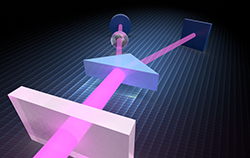
The quantum-enhanced x-ray microscope at NSLS-II will use an experimental technique called ghost imaging. Compared to typical x-ray imaging techniques, which send a single beam of photons (particles of light) through a sample and onto a detector, ghost imaging requires the x-ray beam be split into two streams of entangled photons—only one of which passes through the sample, but both gather information.
“One stream goes through the sample and is collected by a detector that records the photons with good time resolution, while the other stream of photons encodes the exact direction in which the photons propagate,” said Andrei Fluerasu, lead beamline scientist at NSLS-II’s Coherent Hard X-ray Scattering (CHX) beamline, where the microscope will be developed. “It sounds like magic. But with mathematical calculations, we’ll be able to correlate the information from the two beams.”
By splitting the beam, the sample being studied is only exposed to a fraction of the x-ray dose. And since the photons that do not pass through the sample are correlated with the photons that do, the resolution of a full-dose x-ray beam is maintained.
Ghost imaging techniques have already been successfully developed using photons of visible light but translating this technique to x-ray light will be a major scientific achievement.
The quantum-enhanced x-ray microscope at Brookhaven Lab is being developed at NSLS-II’s CHX beamline, which was chosen for its ability to manipulate the coherence of the x-ray source, enabling scientists to tune the ghost imaging experiments as needed. CHX’s existing setup was also flexible enough to accommodate the addition of new and advanced equipment, such as a beam splitter and a new detector. NSLS-II will collaborate with physicists at Brookhaven Lab and Stony Brook University on the integration of these complex instruments.
The team plans to gradually integrate new functionalities into the CHX beamline over the next two to three years. The project will be complete upon demonstrating ghost imaging of micron-sized objects with resolution below 10 nanometers, which is targeted for 2023.
Image – A graphical representation of ghost imaging. In this research technique, scientists split an x-ray beam (represented by the thick pink line) into two streams of entangled photons (thinner pink lines). Only one of these streams of photons passes through the scientific sample (represented by the clear circle), but both gather information. By splitting the beam, the sample being studied is only exposed to a fraction of the x-ray dose. Courtesy of Brookhaven National Laboratory.
************
For more information: