Ferrous alloys are often produced by mixing graphite with iron powder to form a steel or stainless steel. This allows for using lower pressures during compaction of the softer iron powder, which does not contain carbon.
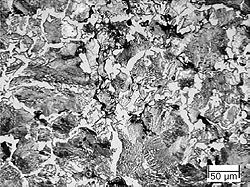
Sintering temperatures are sufficient to lead to a very high mobility of carbon, allowing for good homogeneity of this interstitial element. However, this mobility also means that carbon is free to interact with the atmosphere. This situation is similar to that found in heat-treating wrought or cast steel parts and has similar solutions. Controlling the carbon potential of the atmosphere may be necessary to maintain correct carbon levels. If a part undergoes decarburization during sintering, subsequent hardening treatments could be compromised. A typical microstructure of a press and sintered plain-carbon steel in which carbon was added as graphite is shown in the figure.
For more information, click on the link below (subscription required). Then scroll to Figure 2.
Joseph W. Newkirk, Heat Treatment of Powder Metallurgy Steels, Heat Treating of Irons and Steels, Vol 4D, ASM Handbook, Edited By Jon L. Dossett, George E. Totten, ASM International, 2014, p 253-273, https://doi.org/10.31399/asm.hb.v04d.9781627081689.