Researchers of Karlsruhe Institute of Technology (KIT), Germany, have developed an innovative approach to process tungsten, making this brittle material soft with new process parameters for electron beam melting.
Tungsten has the highest melting point of all metals, 3,422 degrees Celsius making it ideal for use at high temperatures in e.g. space rocket nozzles, heating elements of high-temperature furnaces, or fusion reactors. Tungsten is a metal with very attractive properties: It is corrosion-resistant and as heavy as gold. In the form of tungsten carbide, it is as hard as diamond. And it has the highest melting point of all metals, 3,422 degrees Celsius.
However, the metal is highly brittle at room temperature and difficult to process with conventional methods. Processing is expensive and time-consuming. An alternative is 3D printing that allows producing tungsten components that require hardly any finishing.
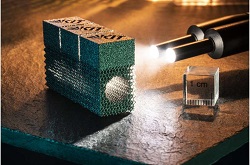
“At the moment, we are working on the additive manufacture of tungsten components by electron beam melting, EBM for short,” says Dr. Steffen Antusch from the Institute for Applied Materials—Materials Science and Engineering of KIT. The team succeeded in adapting the EBM process to tungsten.
Having developed specific process parameters, 3D printing tungsten components is now possible. EBM is an additive manufacturing method. Electrons accelerated under vacuum selectively melt metal powder and, in this way, produce a 3D component layer by layer. The main advantage of this method is its energy source, the electron beam. It is used to pre-heat the metal powder and the carrier plate prior to melting, reducing deformation and inherent stress. It is possible to process materials that easily break at room temperature and can be deformed at high temperature.
However, the materials used must be electrically conductive. Hence, the process is not suited for ceramic materials, as EBM is based on the principle of electric charging.
Originally EBM was developed to process titanium alloys and materials needing higher process temperatures. To date, EBM has been used to produce lightweight titanium components for KIT’s KA-RaceIng formula student project.
Image: Tungsten component produced by 3D printing using electron beam melting. Credit: Markus Breig, KIT
For more information:
KIT Materials Center
www.kit.edu/topics/materials.php
Karlsruhe Institute of Technology
https://www.kit.edu/