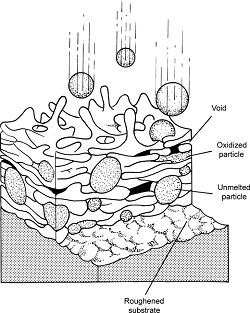
Thermal spray coatings exhibit a unique microstructural architecture. Coatings are formed as melted and partially melted particles of different sizes impact substrates at a rate of perhaps one million particles per second and build up one upon the other. Figure 2 shows the typical lamellar (layered) thermal spray coating microstructure that results from particulate deposition. This unique microstructure imparts several advantages and disadvantages.
Many of the defects identified in Fig. 2 are controllable through appropriate equipment and feedstock selection, but the greatest influence on coating structure comes from the actual processing step. Properties of a sprayed coating stemming from the lamellar shape of the splats and residual porosity can be overcome by post-deposition treatments. Porosity can sometimes be a benefit, as in the cases for oil retention on bearing surfaces, for chemically active structures such as batteries, for bone attachment in orthopedic implants, and so on. Rapid particle cooling rates and the lamellar splat shapes are two features that distinguish thermal spray coatings from other coatings. Brittleness, hardness, anisotropic properties, and residual stresses are the result of very rapidly cooled and flattened particles. Properly applied thermal spray coatings have many uses and offer several advantages.
A wide range of materials can be deposited as coatings, including metals, metal alloys, oxide and nonoxide ceramics, plastics, cermets, and composite structures comprised of metals, ceramics, and plastics, can be applied using thermal spray. Competitive coating processes do not afford this versatility.
Rapid deposition rates on the order of 1 to 45 kg/h (2 to 100 lb/h) or more can be achieved. Typically, 2 to 7 kg/h (5 to 15 lb/h) is normal practice. Rapid spray rates and high deposit efficiencies result in relatively low processing costs.
As of 2012, coating thicknesses from 25 μm to 6.5 mm (0.001 to 0.250 in.) are used. Thicker coatings are possible using electric arc spray, cold spray, and vacuum plasma spray (VPS). Coating capabilities on the basis of thickness have:
• Wide application range. Thermal spray coatings function effectively for a broad range of surface modifications.
• Wear resistance—abrasive, adhesive, galling, antifretting, cavitation, and erosion
• Multilayered thermal barrier coatings comprising metallic bond coats and oxide ceramic topcoats
• Abradable and abrasive coatings for gas-turbine engines
• Atmospheric and aqueous corrosion control
• High-temperature oxidation resistance and corrosion control
• Electrical resistance and conductivity
• Net and near-net shape component manufacturing
• Metal- and ceramic-matrix composite structures
Basic thermal spray equipment is relatively low in cost compared to competitive coating processes and can, to some extent, be made portable. Exceptions to this are VPS and fully integrated thermal spray systems.
With proper control, there is little risk of thermally degrading the substrate during spraying. In terms of substrate interaction, thermal spraying is a relatively “cold” process, and substrates are usually kept below 65 °C (150 °F). Higher temperatures are often used to produce enhanced bonding or unique coating characteristics.
This information is from ASM Handbooks Online, Vol. 5A: Thermal Spray Technology, Coating Structures, Properties, and Materials. To find this information (subscription required), click on the link below and scroll down to Figure 2.
https://dl.asminternational.org/handbooks/book/12/chapter/134972/Introduction-to-Coating-Design-and-Processing
Image – Fig. 2 Thermal spray coating. Buildup of a thermal spray coating is a chaotic process. Molten particles spread out and deform (splat) as they strike the substrate, at first keying onto asperities on the substrate surface, then interlocking to one another. Voids can occur if the growing deposit traps air. Particles overheated in the spray jet can become oxidized. Unmelted particles may simply be embedded in the accumulating deposit.