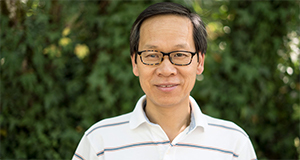
Corban Assistant Professor of Physics, Dr. Yufeng Zhao has partnered with a team at Rice University to conduct groundbreaking new frontier research at the intersection of sustainability and the field of materials science.
Zhao, a long-time professional scientist at the National Renewable Energy Laboratory prior to arriving at Corban, was recruited specifically for this project by one of the world’s preeminent chemists, Dr. James Tour, specifically for his experience and expertise in theoretical modeling of atomic structures.
In collaboration with Tour, Dr. Boris Yakobson, and the Rice University team, Zhao will be researching and investigating a variety of catalytic particles and metallic nanoparticles to determine the efficacy of an exciting new method, published in Nature magazine last year, that has yielded promising results in recycling expensive materials from general waste.
“This method can be used to quickly recycle precious metals from used batteries, which has been a growing problem that we have been facing over the years,” Zhao says. Due to the surprising success of the team’s new method, Zhao has been tasked with using Rice University’s supercomputer, conducting advanced molecular modeling to discover why their process has been so effective.
“Sustainability is a huge topic in modern society,” Zhao says. “We human beings produce a lot of waste. How to regenerate new materials from waste is a big topic. It’s why renewable energy and renewable material science have attracted so much attention in recent years.”
As Zhao’s findings are officially released, reviewed, and discussed by the scientific community, he is excited about the practical ramifications of their recent discoveries. In his classes at Corban, Zhao plans to find ways to involve his students in his exciting new research, hoping to one day expand Corban’s facilities to the point where even more of his science majors can join him at the forefront of scientific discovery. “This frontier research is quite important in education because it’s dealing with topics of public interest,” he says. “Students will find that this is not just interesting, but the best place to apply their knowledge and learning to be able to contribute.”
For more information: Corban University