There are three basic types of grit-blasting equipment:
- Pressure machines or pressure pots
- Suction-type nozzles
- Centrifugal or airless blasting machines
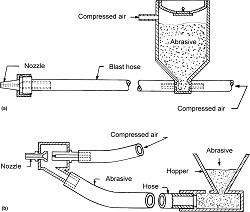
Pressure machines provide higher abrasive speeds and use air more efficiently than suction-feed types (Fig. a). For work on large pieces or for continuous production blasting, suction-type systems are used. Properly engineered systems provide a means for removing dust and ultrafine particles from the abrasive to maintain proper grit sizing.
Suction-type nozzles (Fig. b) do not provide as high an abrasive speed as pressure blasters, and they are less efficient with respect to use of air; however, they are very convenient for small work, on-site/field work, and continuous blasting operations. The abrasive is recycled so that periodic reloading is not required.
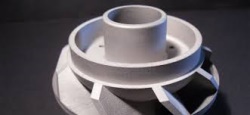
Centrifugal blasting machines are well suited for production blasting, particularly for large parts with thick cross sections. With this equipment, grit is thrown in a fan-shaped pattern against the substrate by a rapidly revolving paddle wheel. In some cases, the work is also rotated to expose all surfaces to the blast. Other machines may use two or more wheels that can be positioned to suit the substrate geometry. This kind of equipment is much more efficient than air-type blast generators in terms of power used.
Image – (a) Pressure-type and (b) suction-type grit-blasting machines. Adapted from Ref 1
This information is from ASM Handbooks Online, Vol. 5A: Thermal Spray Technology, Coating Structures, Properties, and Materials. To find this information (subscription required), click on the link below and scroll down to Figure 6.
https://dl.asminternational.org/handbooks/book/12/chapter/134972/Introduction-to-Coating-Design-and-Processing