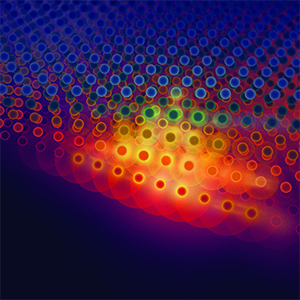
Scientists at the University of Chicago have invented a new way to funnel heat around at the microscopic level: a thermal insulator made using an innovative technique. They stack ultrathin layers of crystalline sheets on top of each other, but rotate each layer slightly, creating a material with atoms that are aligned in one direction but not in the other.
The result is a material that is extremely good at both containing heat and moving it, albeit in different directions—an unusual ability at the microscale, and one that could have very useful applications in electronics and other technology.
“The combination of excellent heat conductivity in one direction and excellent insulation in the other direction does not exist at all in nature,” said study lead author Jiwoong Park, professor of chemistry and molecular engineering at the University of Chicago. “We hope this could open up an entirely new direction for making novel materials.”
Scientists are constantly on the search for materials with unusual properties because they can unlock completely new capabilities for devices such as electronics, sensors, medical technology, or solar cells. For example, MRI machines were made possible by the discovery of a strange material that can perfectly conduct electricity.
Park’s group had been investigating ways to make extremely thin layers of materials, which are just a few atoms thick. Normally, the materials used for devices are made up of extremely regular, repeating lattices of atoms, which makes it very easy for electricity (and heat) to move through the material. But the scientists wondered what would happen if they instead rotated each successive layer slightly as they stacked them.
They measured the results and found that a microscopic wall made of this material was extremely good at preventing heat from moving between compartments. But the point that was really exciting for the scientists was when they measured the material’s ability to transport heat along the wall and found it could do so very easily.
That capability could open doors to experiment with materials that have been too heat-sensitive for engineers to use in electronics. In addition, creating an extreme thermal gradient—where something is very hot on one side and cool on the other—is difficult to do, particularly at such small scales, but could have many applications in technology.
For more information: University of Chicago