Carbonitriding is a modified form of gas carburizing that uses additions of up to 10% ammonia into the gas carburizing atmosphere resulting in adding nitrogen to the carburized case. It produces a more consistent surface hardness profile, which improves wear resistance and toughness of the PM steel.
Dissociated nitrogen forms at the workpiece surface from the ammonia in the furnace atmosphere. Nitrogen diffuses into the steel surface simultaneously with carbon, retarding the critical cooling rate on quenching and leading to a more consistent martensite transformation. Process temperatures for carbonitriding are lower, 800–850 °C (1470–1560 °F), providing better control of distortion than carburizing.
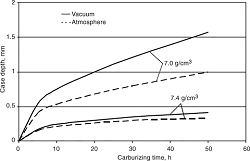
Carbonitriding is a shallow case-hardening treatment. Case depths greater than 0.5 mm (0.02 in.) are seldom specified. For this reason, cycle times are relatively short, usually on the order of 30–60 minutes. As in neutral hardening, carbon control is a critical aspect of the treatment. Normally, carbon potentials of 1.0–1.2% are specified to maintain the carbon profile in the part.
For more information, click on the link below (subscription required). Then scroll to Figure 29.
Joseph W. Newkirk, Heat Treatment of Powder Metallurgy Steels, Heat Treating of Irons and Steels, Vol 4D, ASM Handbook, Edited By Jon L. Dossett, George E. Totten, ASM International, 2014, p 253-273, https://doi.org/10.31399/asm.hb.v04d.9781627081689