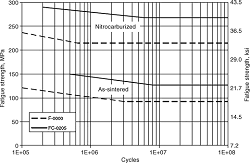
Powder metallurgy parts can be nitrided using alkali salts, gases, and plasmas, with the majority of applications using gases. Alkali salts can be used in some applications, because trapped salts may not be detrimental if the part is constantly immersed in oil during service. This disadvantage can be negated and increases in fatigue strength of 100% can be achieved.
Gas nitriding is most often done in ammonia and nitrogen-containing ammonia. Dissociation of ammonia in the presence of iron at temperatures above 450 °C (840 °F) is used to nitride up to ∼950 °C (∼1740 °F). However, gas nitriding is typically performed at temperatures below 590 °C (1095 °F), as higher temperatures can lead to complete nitriding of the iron. Depths of 0.5–1 mm (0.02–0.04 in.) are achieved in the range of 540 to 560 °C (1005 to 1040 °F).
For more information, click on the link below (subscription required). Then scroll to Figure 30.
Joseph W. Newkirk, Heat Treatment of Powder Metallurgy Steels, Heat Treating of Irons and Steels, Vol 4D, ASM Handbook, Edited By Jon L. Dossett, George E. Totten, ASM International, 2014, p 253-273, https://doi.org/10.31399/asm.hb.v04d.9781627081689