Using a new laser-based Volumetric Additive Manufacturing (VAM) approach—an emerging technology in near-instant 3D printing—researchers at Lawrence Livermore National Laboratory and the University of California, Berkeley have demonstrated the ability to 3D-print microscopic objects in silica glass, part of an effort to produce delicate, layer-less optics that can be built in seconds or minutes. The results are reported in the latest edition of the journal Science.
Versatile and ubiquitous, glass is increasingly found in specialized applications such as fiber optics, consumer electronics and microfluidics for “lab-on-a-chip” devices. However, traditional glassmaking techniques can be costly and slow, and 3D-printing glass often results in rough textures, making them unsuitable for smooth lenses.
Nicknamed “the Replicator” after the fictional device in “Star Trek” that can instantly fabricate nearly any object, the Computed Axial Lithography (CAL) technology developed by LLNL and UC Berkeley is inspired by computed tomography (CT) imaging methods. CAL works by computing projections from many angles through a digital model of a target object, optimizing these projections computationally, and then delivering them into a rotating volume of photosensitive resin using a digital light projector. Over time, the projected light patterns reconstruct, or build up, a 3D light dose distribution in the material, curing the object at points exceeding a light threshold while the vat of resin spins. The fully formed object materializes in mere seconds—far faster than traditional layer-by-layer 3D printing techniques—and then the vat is drained to retrieve the part.
Combining a new microscale VAM technique called micro-CAL, which uses a laser instead of an LED source, with a nanocomposite glass resin developed by the German company Glassomer and the University of Freiburg, UC Berkeley researchers reported the production of sturdy, complex microstructure glass objects with a surface roughness of just six nanometers with features down to a minimum of 50 microns.
UC Berkeley associate professor of mechanical engineering Hayden Taylor, the project’s principal investigator, said the micro-CAL process, which produces a higher dose of light and cures 3D objects faster and at higher resolution, combined with the nanocomposite resins characterized at LLNL proved a “perfect match for each other,” creating “striking results in the strength of the printed objects.”
Glass objects tend to break more easily when they have more flaws or cracks or a rough surface, so there is a large potential advantage to making objects with smoother surfaces than other 3D printing processes. The benefit of VAM for micro-optics is that it can produce extremely smooth surfaces without layering artifacts, resulting in faster printing without additional time for post-processing steps such as polishing.
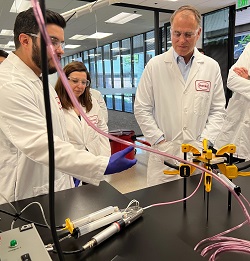
Image – Courtesy of: Adam Lau/Berkeley Engineering.
For more information:
Lawrence Livermore National Laboratory