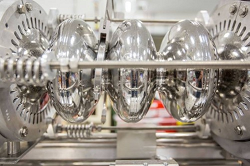
Virgina Tech, Va., scientists have developed a new theoretical model for preparing particle accelerator structures made of niobium metal. The model predicts the rate of oxygen diffusion into niobium on heat treatment.
The oxygen in the thin oxide layer on the surface of the niobium metal moves deeper into the metal with heating. This happens as the oxide layer dissolves during gentle heating. This heating is part of how a particle accelerator is made and prepared for use. Tests show that the model accurately describes the concentration profile of oxygen in niobium samples after the heat treatment. The tests also indicate that the treatment improves accelerator structure performance.
Engineers and researchers compare the tradition of crafting world-class particle accelerator structures to perfecting a recipe – it takes trial and error. Using this new theoretical model would, for the first time, allow designers to customize the accelerator structure preparation recipe without losing time to trial-and-error testing. The model offers a way to fine-tune the inclusion of impurities near the surface. Now this fine-tuning can be done in a simpler process with fewer steps. The model may help accelerator builders predict the optimum recipe for their needs.
Read further here.