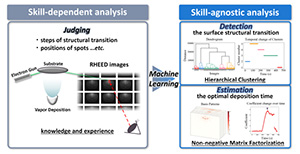
The development of new thin semiconductor materials requires a quantitative analysis of a large amount of reflection high-energy electron diffraction (RHEED) data, which is time consuming and requires expertise. To tackle this issue, scientists from Tokyo University of Science identify machine learning techniques that can help automate RHEED data analysis. Their findings could greatly accelerate semiconductor research and pave the way for faster, energy efficient electronic devices.
Unfortunately, for all its benefits, RHEED is sometimes hindered by the fact that its output patterns are complex and difficult to interpret. In virtually all cases, a highly skilled experimenter is needed to make sense of the massive amounts of data that RHEED can produce in the form of diffraction patterns. But what if we could make machine learning do most of the work when processing RHEED data?
A team of researchers have been working on just that. In their latest study, the team explored the possibility of using machine learning to automatically analyze RHEED data.
The researchers focused on the surface superstructures that form on the first atomic layers of clean single-crystal silicon (one of the most versatile semiconductor materials). Surface superstructures are atomic arrangements unique to crystal surfaces where atoms stabilize in different periodic patterns than those inside the bulk of the crystal, depending on differences in the surrounding environment. Because they often exhibit unique physical properties, surface superstructures are the focus of much interest in materials science.
First, the team used different hierarchical clustering methods, which are aimed at dividing samples into different clusters based on various measures of similarity. This approach serves to detect how many different surface superstructures are present. After trying different techniques, the researchers found that Ward’s method could best track the actual phase transitions in surface superstructures.
Overall, the findings reported in this study will hopefully lead to new and effective ways of using machine learning techniques for materials science—a central topic in the field of materials informatics. In turn, this would have implications in our everyday lives as existing devices and technologies are upgraded with better materials.
For more information: Skill-Agnostic analysis of reflection high-energy electron diffraction patterns for Si(111) surface superstructures using machine learning