Austenitizing is the most critical of all heating operations performed on tool steels. Along with quenching it will usually be referred to as the hardening step in tool steel heat treatment and, associated with tempering, will be responsible for the final properties.
The correct application of hardening thus will be necessary for the full performance of most tool steel and the control of a good or badly performed heat hardening often is difficult in nondestructive testing. Hardness often is used, but several examples show that, for tool steels, attaining the hardness is definitively not enough to indicate a proper heat treatment.
Excessively high austenitizing temperatures or abnormally long holding times may result in excessive distortion, abnormal grain growth, loss of ductility, and low strength; this is especially true for high-speed steels, which are frequently austenitized at a temperature close to that at which melting begins. Underheating may result in low hardness and low wear resistance.
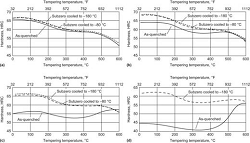
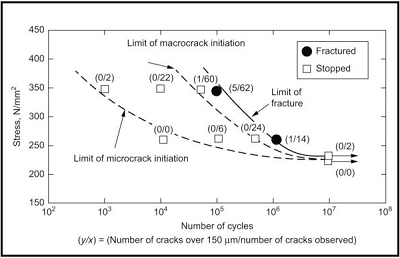
For more information, click on the link below (subscription required). Then scroll to Figure 2.
Rafael A. Mesquita; Reinhold E. Schneider, Introduction to Heat Treating of Tool Steels, Vol 4D, ASM Handbook, Edited By Jon L. Dossett, George E. Totten, ASM International, 2014, https://doi.org/10.31399/asm.hb.v04d.a0005946