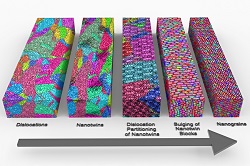
Massachusetts Institute of Technology has published a new study that shows what happens when crystalline grains in metals reform at nanometer scales, improving metal properties. This includes recrystallization, in which the metal is deformed and heated.
Forming metal into the shapes needed for various purposes can be done in many ways, including casting, machining, rolling, and forging. These processes affect the sizes and shapes of the tiny crystalline grains that make up the bulk metal, whether it be steel, aluminum or other widely used metals and alloys.
Researchers at MIT have been able to study exactly what happens as these crystal grains form during an extreme deformation process, at the tiniest scales, down to a few nanometers across. The new findings could lead to improved ways of processing to produce better, more consistent properties such as hardness and toughness.
The new findings, made possible by detailed analysis of images from a suite of powerful imaging systems, are reported today in the journal Nature Materials, in a paper by former MIT postdoc Ahmed Tiamiyu (now assistant professor at the University of Calgary); MIT professors Christopher Schuh, Keith Nelson, and James LeBeau; former student Edward Pang; and current student Xi Chen.
Read further here.