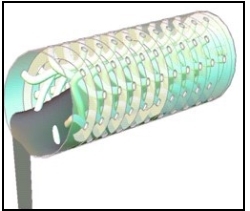
During spraying, it is necessary to control the temperature of both the sprayed coating and the substrate to avoid substrate degradation, oxidation, and coating failure due to differential expansion.
As with preheating, mentioned previously, there are limitations to substrate temperature during spraying. Lower-temperature-substrate materials or matrix materials may be damaged by allowing the part to overheat during the spray process.
Coating layers deposited and allowed to reach high temperatures during spraying will oxidize and appear to darken. Surface oxides so formed leave a plane of weakness in the coating, between passes, and could lead to delamination under applied stress during service. The critical oxidizing temperature for each material varies.
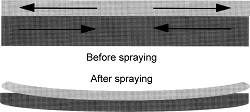
Controlling the CTE mismatch between the coating and substrate follows the same guidelines as mentioned under the preheating section. Along with the substrate, sprayed coatings shrink as they cool. The CTE differences can exert considerable shear stress along the interface and lead to possible separation or distortion (as seen in the image). Substrate materials having a high CTE that are allowed to expand because of high temperatures during the spray process will experience catastrophic disbonding at the substrate/coating interface.
The sprayed metal cools, creating a tensile stress in the coating and a compressive stress in the underlying substrate material. These stresses may deform the substrate or weaken the bond between the sprayed coating and the substrate, leading to debonding of the coating. The bottom illustration shows deformation of a thin-section substrate and debonding of the coating due to stresses generated by cooling of the sprayed metal.
Image – Effect of coating shrinkage on interfacial shear stresses. The sprayed metal cools, creating a tensile stress in the coating and a compressive stress in the underlying substrate material. These stresses may deform the substrate or weaken the bond between the sprayed coating and the substrate, leading to debonding of the coating. The bottom illustration shows deformation of a thin-section substrate and debonding of the coating due to stresses generated by cooling of the sprayed metal. Adapted from: T.F. Bernecki, Ed., Thermal Spray Research and Applications, Proc. Third National Thermal Spray Conf., May 20–25, 1990 (Long Beach, CA), ASM International, 1991.
This information is from ASM Handbooks Online, Vol. 5A: Thermal Spray Technology, Coating Structures, Properties, and Materials. To find this information (subscription required), click on the link below and scroll down to Figure 18.
https://dl.asminternational.org/handbooks/book/12/chapter/134972/Introduction-to-Coating-Design-and-Processing