Physicists have been riveted by systems composed of materials only one or a few layers of atoms thick. When a few sheets of these two-dimensional materials are stacked together, a geometric pattern called a moiré pattern can be formed. In these so-called moiré systems, new, exotic phenomena can occur, including superconductivity and unconventional magnetism. As a result, a better understanding of what happens at the interface between each sheet to cause these phenomena could lead to heady applications in novel electronics and much more.
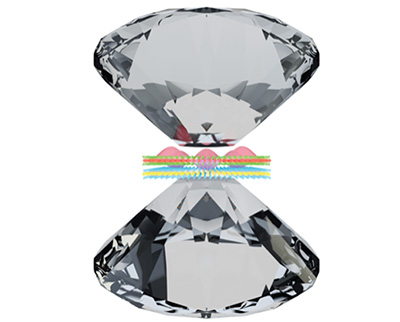
Now an international team of scientists led by physicists at MIT reports a powerful new tool for quantifying — and controlling — a key parameter in moiré systems. It involves applying extreme pressure to a moiré system while shining light through it, then analyzing the effects with Raman spectroscopy, a common laboratory technique. Equally important to the work is a theoretical model that provides a framework for understanding the experimental data.
“The technique we developed for probing these moiré systems is methodologically similar to the methods of X-ray crystallography on proteins that allow biologists to know where the atoms are in a protein and how the protein is going to work,” says Riccardo Comin, the Class of 1947 Career Development Assistant Professor of Physics at MIT.
The parameter the team can now measure, known as the moiré potential, “is going to tell us what physics can be realized in a particular stack of two-dimensional materials. It is one of the most important pieces of information that we need for predicting if a given material is going to exhibit any exotic physics, or not,” continues Comin, who is also affiliated with MIT’s Materials Research Laboratory.
Just as importantly, the technique also allows the team to “tune,” or control, the moiré potential to potentially achieve different exotic phenomena.
Comments Matthew Yankowitz, an assistant professor of physics at the University of Washington who was not involved in the work: “Pressure has recently emerged as a promising technique for tuning the properties of these [moiré] materials because it directly modifies the strength of the moiré potential. By studying the optical properties of a semiconducting moiré bilayer under pressure, the team has unlocked a new means of probing and manipulating the effects of a moiré superlattice. This work lays the foundation for further advances in our understanding and control of the strongly correlated states of matter arising in semiconducting moiré systems.”
For more information: Nature Nanotechnology