A new nanoscience study, led by the Department of Energy’s Oak Ridge National Laboratory, takes a big-picture look at how scientists study materials at the smallest scales. Their research in subsurface nanometrology, the science of internal measurement at the nanoscale level, suggests quantum sensing could become the foundation for the field’s next era of discoveries.
“Our goal was to define the state of the art and to consider what’s been done and where we need to go,” said Ali Passian, an ORNL senior research scientist and senior author of the study.
“Everybody wants to know what’s below the surface of materials, but finding out what’s really there tends to be incredibly challenging at any scale. We hope to inspire a new generation of scientists to tackle this challenge by exploiting quantum phenomena or whatever the most promising opportunities may be, so we can push the boundaries of sensing and imaging science toward greater discoveries and understanding.”
Particles at the nanoscale act as the building blocks of quantum science—just small enough to enable scientists to tweak major properties of materials with maximum precision. One nanometer equals a billionth of a meter, a millionth of a millimeter and a thousandth of a micrometer. The average sheet of paper, for example, runs about 100,000 nanometers thick.
Breakthrough tools like the scanning probe microscope, which uses a sharp-tipped probe to inspect samples at the atomic level, have helped speed advances in the nanometrology of surfaces. Subsurface studies have achieved fewer comparable breakthroughs, the authors note.
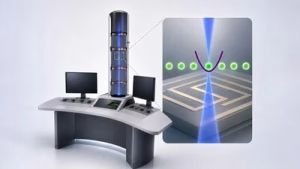
“The authors suggest quantum sensing techniques now in the early stages of development could hold the key to advances in subsurface exploration. Quantum probes, for example, could employ skyrmions—subatomic quasiparticles created by disruptions in magnetic fields and already under consideration for other quantum applications—to probe deeper than any current technique allows.
“People are working hard to push the limits of detection and create new measurement modalities,” Passian said. “I think the next few years will be exciting in terms of materialization and user-friendly implementation of these techniques toward achieving quantum nanometrology of surfaces and the subsurface regions.”
Their paper was published in Science Advances.
Image –In this example of mechanical excitation for subsurface imaging, the specimen is driven at acoustic or ultrasonic frequencies, while the probe remains engaged with the surface.
************
For more information:
Oak Ridge National Laboratory