The U.S. National Science Foundation (NSF) is looking for materials that “revolutionize and engineer our future.”
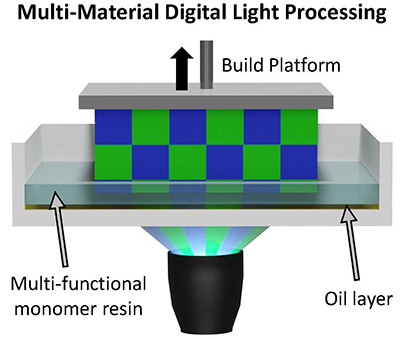
Researchers at Iowa State University and the University of California, Santa Barbara think they can do just that by fundamentally changing Digital Light Processing – a type of 3D printing that uses light rather than heat to quickly cure and harden liquid resin into plastic layers – to enable multi-material printing.
“We want to produce two material properties with the same resin,” said Adarsh Krishnamurthy, an associate professor of mechanical engineering and leader of the project at Iowa State. “That’s revolutionary in terms of materials for 3D printing.”
The researchers are using their expertise in materials chemistry, computational science, machine learning and materials characterization to find resins that, when exposed to different wavelengths of light, will solidify with different properties.
So, with one material, Digital Light Processing 3D printers could create products that are rigid in some places and flexible in others.
The project is one of 37 that NSF announced in September as part of a four-year, $72.5 million investment to “create novel materials to address grand societal challenges and develop the scientific and engineering workforce of tomorrow.” The effort is part of the federal, multi-agency Materials Genome Initiative that’s focused on quickly advancing materials invention and use.
The program awarded Iowa State researchers $800,000 to use artificial intelligence and machine learning algorithms to help develop new resins that can be printed with different properties. Krishnamurthy said the Iowa State team’s experience with machine learning tools will help the researchers evaluate options and quickly identify potential materials.
In addition to printing and testing actual materials, the researchers will develop a “digital twin” of the system. They can use this to simulate and predict how different resins will respond to a spectrum of light wavelengths and exposures.
Machine learning tools will also save the researchers tedious, time-consuming lab work by trimming the list of potential resins suitable for study and development.
In addition, the researchers will use a machine learning technique called reinforcement learning to make sure advances in experiments or theories lead to overall advancements of multi-material, light-based 3D printing.
All that computational science can help the Iowa State team advance the Materials Genome Initiative’s goal of “discovering, manufacturing, and deploying advanced materials twice as fast and at a fraction of the cost compared to traditional methods.”
For more information: Iowa State University https://www.news.iastate.edu/news/2023/10/18/multimaterial
Image: This illustration shows a single resin producing two materials with different properties during light-based 3D printing. Larger illustration. Figure contributed by Adarsh Krishnamurthy.