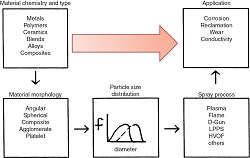

This section provides an understanding for choosing particular feedstock materials. The image represents relationships between the material chemistry, material morphology, size distribution, TS process, and the intended application. It is intended to demonstrate that the initial chemistry and form of the feedstock material is of utmost importance with regard to the engineering application. The following indicates that powder processing and powder quality can be considered from many viewpoints.
The nature of the particular TS process is directly related to the types of materials that can be sprayed by that process. For example, arc metallization requires that the feedstock be in the form of electrically conducting wires. It is clear that the material cannot be an insulating ceramic or polymer; however, it may not be as obvious that nonconducting materials can be inserted into conducting tubes so that arc metallization procedures can be utilized. The powder feed can also be controlled by incorporating the powder into discrete lots that are individually added into the thermal spray stream.
The types of TS processes are covered elsewhere in this Volume, but, for completeness, the following list encompasses the prime TS process variants: oxyacetylene gas flame spraying (e.g., flame spraying, combustion spraying, the Rokide process), atmospheric plasma spraying and liquid-stabilized plasma torches, low-pressure plasma spraying (LPPS) and vacuum plasma spray (VPS), high-velocity oxygen fuel processes (e.g., Jet Kote by Deloro Stellite Holdings Corp., DJ Gun, and others), D-Gun (a trademark of Praxair Surface Technologies Inc.) technology, and arc metallization and wire spraying.
The temperature and velocity of the process must be matched to the feedstock characteristics. Processes such as flame spraying have relatively low temperatures and velocities and therefore may not melt high-melting-point ceramics. One way of overcoming this type of problem would be to decrease the average particle size; however, this creates another range of difficulties that are associated with reliable feeding of material. This conflict in melting ability (sometimes referred to as meltability) of the feedstock with respect to process conditions can be resolved by changing to a TS technique that employs a more intense heat source, such as plasma spraying, high-velocity oxygen fuel, or the detonation gun. Thus, a measure of the characteristics of a certain feedstock can be gauged from examining the spray performance under certain processes.
Another process of unique importance is LPPS (or VPS) because this allows the processing of reactive metals such as titanium and nickel alloys in an inert environment. These metal alloy materials would oxidize under ambient spray conditions, and the oxide boundaries formed result in poor high-temperature performance of such coatings. The LPPS process has, on the other hand, no particular advantage for the spraying of ceramic materials because they do not chemically degrade during spraying. Thus, the point being made is that certain behavior of a material during thermal spraying can be controlled by altering the process. Thermal interactions of the superheated feedstock particles with the environment can be controlled by flooding the working area with an inert gas such as argon. This is called a shrouded gas environment.
A discussion of any TS process will also include a set of variables that are collectively known as the TS parameters, or the “spray parameters” in thermal spray jargon. A summary of TS parameters would include powder specifications, including chemistry, size distribution, morphology, and density; powder feed rate; thermal spray gas pressures and consumption rates; deposition efficiency; torch-to-substrate distance, also known as the stand-off distance; equipment specification; substrate surface preparation; and coating thickness or coating layer thickness if a multilayered system has been designed.
It is essential to point out that even with similar thermal spray processes, these parameters are likely to change from process to process and among different equipment. Powders that are presumably identical may also have different spray parameters for each set of equipment.
Image – Relationships between material chemistry and the intended application. LPPS, low-pressure plasma spray; HVOF, high-velocity oxyfuel.
This information is from ASM Handbooks Online, Vol. 5A: Thermal Spray Technology, Coating Structures, Properties, and Materials. To find this information (subscription required), click on the link below and scroll down to Figure 12.
https://dl.asminternational.org/handbooks/edited-volume/12/chapter/133823/Feedstock-Material-Considerations-for-Thermal