Researchers at the Department of Energy’s (DOE) Pacific Northwest National Laboratory, Richland, Wash., found that adding a small amount of solid carbon to copper boosts its ability to conduct electricity—industry applications abound.
The findings, reported December 2023 in the journal Materials & Design, could lead to more efficient electricity distribution to homes and businesses, as well as more efficient motors to power electric vehicles and industrial equipment. The team has applied for a patent for the work, which was supported by the DOE Advanced Materials and Manufacturing Technologies Office.
Materials scientist Keerti Kappagantula and her colleagues discovered that graphene, single layers of the same graphite found in pencils, can enhance an important property of metals called the temperature coefficient of resistance. This property explains why metal wires get hot when electric current runs through them. Researchers want to reduce this resistance while enhancing a metal’s ability to conduct electricity. For several years they have been asking whether metal conductivity be increased, especially at high temperatures, by adding other materials to it. And if yes, can these composites be viable at commercial scale?
Now, they’ve demonstrated they can do just that, using a PNNL-patented advanced manufacturing platform called ShAPE. When the research team added 18 parts per million of graphene to electrical-grade copper, the temperature coefficient of resistance decreased by 11 percent without decreasing electrical conductivity at room temperature. This is relevant for the manufacturing of electric vehicle motors, where an 11 percent increase in electrical conductivity of copper wire winding translates into 1 percent gain in motor efficiency.
“This discovery runs counter to what’s generally known about the behavior of metals as conductors,” said Kappagantula. “Typically, introducing additives into a metal increases its temperature coefficient of resistance, meaning they heat up faster at the same current levels compared to pure metals. We are describing a new and exciting property of this metal composite where we observe enhanced conductivity in a manufactured copper wire.”
In a prior study, the research team performed detailed structural and physics-based computational studies to explain the phenomenon of enhancing the electrical conductivity of metals using graphene. They showed the solid-phase processing used to extrude the composite wire leads to a uniform, near pore-free microstructure punctuated with tiny flakes and clusters of graphene that may be responsible for decreasing coefficient of resistance of the composite. The flakes and clusters must both be present to make better conductors for high-temperature operations.
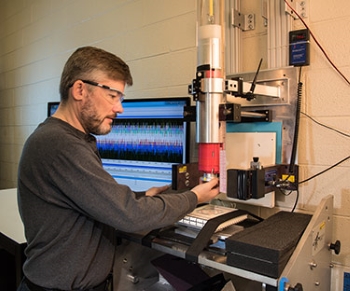
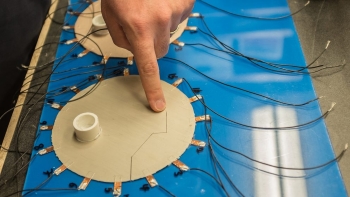
Tests on a PNNL-designed testbed that measures electrical properties with high precision and accuracy validated the improved conductivity. The tooling and process envelopes for the solid-phase friction extrusion process helped lead to the patent.
The team believes anywhere there’s electricity, there’s a use case. When applied to any industrial application, the new copper-graphene composite wires will provide great design flexibility.
For example, coiled copper wire forms are used in the core of electric motors and generators. Motors today are designed to operate within a limited temperature range because when they get too hot, the electrical conductivity drops dramatically. With the new copper-graphene composite, motors could potentially be operated at higher temperatures without losing conductivity.
Likewise, the wiring in high-density urban settings that brings electricity from transmission lines into homes and businesses is typically made of copper. As the population density of cities increases, demand for power follows suit. A composite wire that is more conductive could potentially help meet that demand with efficiency savings.
The research team continues its work to customize the copper-graphene material and measure other essential properties, such as strength, fatigue, corrosion, and wear resistance—crucial to qualify such materials for industrial applications. For these experiments, the research team is manufacturing wires that are about the thickness of a US penny (1.5 millimeters).
Image – Xiao Li, a materials scientist, holds samples of highly conductive metal wires created on the patented Shear Assisted Processing and Extrusion platform. Courtesy of: Andrea Starr, Pacific Northwest National Laboratory.
For more information:
Pacific Northwest National Laboratory