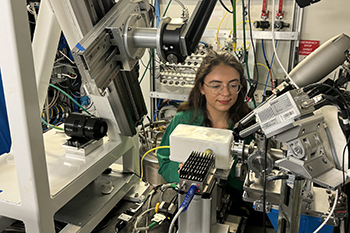

Researchers at Oak Ridge National Laboratory, (ORNL), Oak Ridge, Tenn., demonstrated that stainless steel and other metal alloys coated with hexagonal boron nitride, or hBN, exhibit non-stick or low-friction qualities along with improved long-term protection against harsh corrosion and high-temperature oxidation in air.
Hexagonal boron nitride coatings on metal alloys enhance durability, reduce friction, and protect against harsh conditions, paving the way for improvements in solar panels, semiconductors, and aerospace components.
Metal alloys are created to be strong, durable, and resistant to corrosion or oxidation. By adding coatings, or “armor,” to make those materials even tougher, scientists could enhance existing products and enable the creation of new, innovative ones.
For example, armoring may boost the ability of solar panels to conduct heat and resist environmental factors. Additionally, it allows semiconductors to maintain proper operating temperature, and aerospace turbine blades to guard against wear, reduce friction and withstand hot conditions.
ORNL’s hBN coatings are produced from a combination of solid boron sources and molecular nitrogen by a process called atmospheric pressure chemical vapor deposition.
“This synthesis technique addresses scalability issues such as cost and process safety in applications where those aspects have been problematic,” said ORNL’s Ivan Vlassiouk, who led the study on these materials published in Advanced Materials Interfaces. “Besides providing a versatile protective layer for steels and metals, using this process to synthesize single- and few-layer hBN for emerging two-dimensional electronic and photonic devices could improve their performance.”
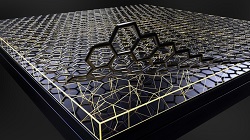
Image – Scientists applied a simple approach for growing hBN films on the surface of ubiquitous steels and other metal alloys to “armor” them and thus increase their capabilities. Courtesy of: Adam Malin/ORNL, U.S. Dept. of Energy.
For more information:
Oak Ridge National Laboratory