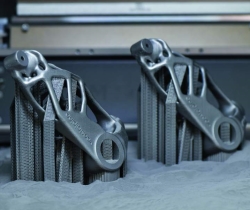
3D printing technology creates objects by adding molten plastic or metal layers, but this technique is limited to larger sizes. Scientists have questioned how to manufacture microdevices that cannot be produced using layering and whether it is conceivable to directly print inside a pre-existing three-dimensional material.
The teams led by Lynford Goddard and Paul Braun, both faculty members at the University of Illinois Urbana-Champaign, have collaborated to develop a procedure for this purpose. They employed multiphoton lithography to imprint a pre-existing permeable substance by applying a high-intensity laser beam.
The scientists achieved the alteration of specific areas inside the substance and the creation of personalized miniature optical devices using a technique called subsurface controllable refractive index via beam exposure (SCRIBE).
Both research teams have announced an improvement to this process, allowing for greater precision in the final products. The details of this new procedure have recently been released by ACS Photonics.
The SCRIBE process utilizes two-photon absorption as a mechanism for multiphoton lithography. Transparent silica is created by oxidizing silicon that has been etched to contain microscopic pores, according to scientists.
Subsequently, the pores are filled with a substance known as photoresist, which undergoes a chemical reaction altering its optical characteristics upon the simultaneous absorption of two photons. This phenomenon is infrequent unless extremely strong light is used.
Scientists employ this technique by focusing laser beams to generate high magnitudes in specific areas. This enables them to create customized blueprints for the optical features of the substance in three dimensions, essentially “writing” optical components.
Earlier versions of SCRIBE were limited by inadequate control over the laser’s intensity. To address this, the researchers propose three enhancements to the method in their study. Firstly, they utilize a two-photon fluorescence imaging mechanism to map the density of the photoresist and adjust the laser power required for the desired outcome.
They also rectify discrepancies that are particularly noticeable near the writing perimeter by adjusting the placement of the substance during laser inscription. Lastly, they incorporate a temporal gap between laser bursts to minimize time-related impacts on the interaction with the photoresist.
By implementing these three enhancements, the scientists achieved greater control over their patterned devices, resulting in more accurately produced components with higher efficiency.
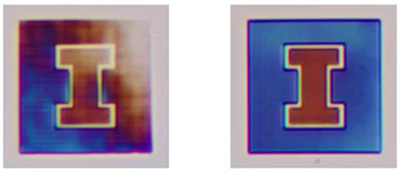
To demonstrate the versatility of their technique, they produced a 100-by-100-micrometer optical device that modifies light to create specific chromatic designs, including a linear diffraction grating that replicates the configuration and colors of the UIUC emblem.
Goddard serves as a faculty member in electrical and computer engineering, while Braun is employed as a faculty member in materials science and engineering.
Contributions to this study were made by Littlefield, graduate students Lawrence Ju, Jingxing Gao, and Lonna Edwards from Goddard’s team, and Dajie Xie, Corey Richards, and Christian Ocier from Braun’s team, as well as undergraduate students Haibo Gao and Jonah Messinger.
The research staff at UIUC and the University of Illinois Chicago, including individuals such as Jeff Grau, Austin Cyphersmith, Anuj Singhal, and Seyoung An, provided assistance with the experiments.
The study received partial funding from The Grainger College of Engineering at UIUC, the National Science Foundation, and the Department of Energy. Additional support was provided through fellowships granted by the Department of Defense and UIUC.
For more information: ACS Photonics
Image: A line grating fabricated with SCRIBE to form the UIUC “I” logo with accurate colors. The left was fabricated without improvements, and the right grating incorporates the improvements. Image Credit: University of Illinois Urbana-Champaignrepresent the stress-sensing components.