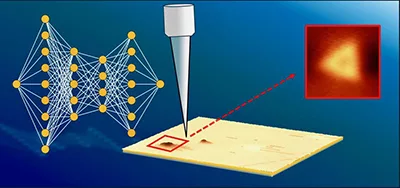
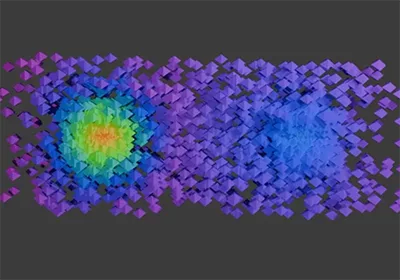
Researchers at Oak Ridge National Laboratory have introduced a powerful new method for investigating the atomic-level behavior of materials by combining Bayesian deep learning—a fusion of probability theory and neural networks—with advanced data analysis. This approach enables scientists to rapidly and accurately process complex datasets, allowing them to scan broader sample areas and identify regions with critical properties far more efficiently than traditional techniques.
“This method makes it possible to study a material’s properties with much greater efficiency,” said Ganesh Narasimha from ORNL. “Usually, we would need to scan a large region, and then several small regions, and perform spectroscopy, which is very time-consuming. Here, the AI algorithm takes control and does this process automatically and intelligently.”
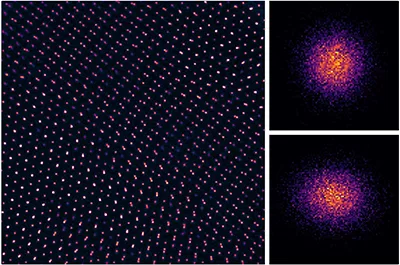
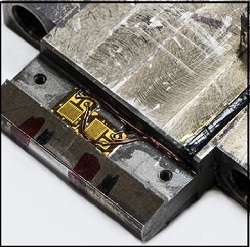
The team demonstrated the system using europium zinc arsenide, a magnetic semimetal with distinctive electronic traits. With the aid of scanning tunneling microscopy, the researchers uncovered links between atomic-scale structures and their electronic responses.
Although the case study focused on europium zinc arsenide, the scientists emphasize that the method is broadly applicable to many different materials. The advance not only streamlines the discovery process but also strengthens national efforts in artificial intelligence and quantum science.
For more information: Nature
Image: A scanning tunneling microscope and machine learning algorithm autonomously search for atomic structures. This image shows a vacancy defect on europium zinc arsenide. (Image Credit: Ganesh Narasimha/ORNL, U.S. Dept. of Energy)