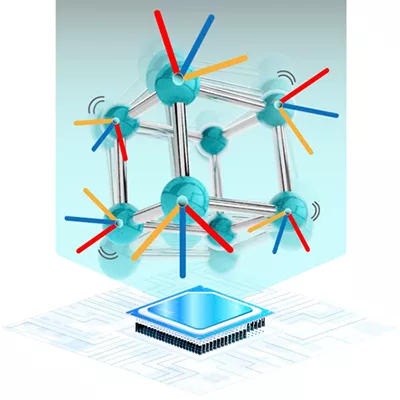
Scientists and engineers at Johns Hopkins Applied Physics Laboratory (APL) are pioneering a new approach to materials science that leverages artificial intelligence and robotics to dramatically speed up the design, testing, and optimization of metal components critical to national defense. This initiative, called TETRA (Transforming Evaluation and Testing via Robotics and Acceleration), reimagines the traditional materials science framework — known as the tetrahedron — by integrating advanced automation and accelerated testing methods. The goal is to overcome current limitations in the defense industrial base, which struggles to meet demand for both legacy and advanced metallic components due to slow alloy qualification processes.
Funded by the Department of Defense’s Industrial Base Analysis and Sustainment Program, TETRA aims to revolutionize how materials are evaluated, enabling rapid deployment of high-performance alloys. According to Sal Nimer, assistant program manager for APL’s Science of Extreme and Multifunctional Materials program, this effort could significantly enhance the speed and efficiency of producing and qualifying materials, helping the DoD maintain existing systems while unlocking new capabilities.
“It takes a really long time, it’s really expensive and it’s inefficient,” Lambert said. “With the TETRA lab, we’re working to simultaneously explore all of the different composition and processing variants that influence properties and performance — or at least we aim to do this significantly more rapidly.”
Their approach leverages a method known as combinatorial synthesis to study a variety of chemical compositions. TETRA expands on the standard implementations, which are too limited in size and scale for the rigors of fielded equipment, Lambert explained.
“Materials perform quite differently when scaled up in size, so we are developing methods that focus on development and size scales of interest,” he said. “And traditional combinatorial synthesis often doesn’t account for critical effects of heat treatment and the hot work from forging and other production processes. Our approach will enable understanding and consideration for all of these effects as we develop new alloys and scalable processing approaches.”
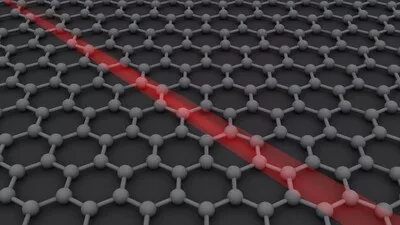
TETRA is leveraging an additive manufacturing technique called blown-powder directed energy deposition, or DED. The process involves a laser melting metal powder as it’s fed into the build area, where it quickly solidifies. This allows for the creation, layer by layer, of dense metal structures, and chemical compositions can be varied in each sample. A single build plate can contain hundreds of alloys, printed into custom-designed 3D specimens, ready to be autonomously tested.
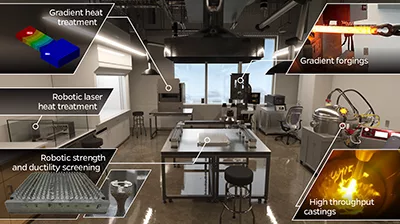
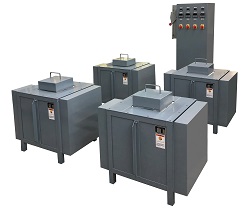
In addition to fabrication via additive manufacturing, the lab will feature a state-of-the-art melting furnace for ultrafast synthesis of custom castings from raw material, custom heat treatment furnaces and hot forging equipment for shaping material and modifying its microstructure, and robotic mechanical property measurement. This combination of capabilities will make TETRA an all-in-one materials research and development facility — the first of its kind.
These same tools for discovering new materials will also enable researchers to troubleshoot the manufacturing of legacy parts, Lambert said, helping to identify why a “surprisingly high” number of parts are rejected for poor properties, even when the root cause of these poor properties is not always clear. “One envisioned future use for the TETRA lab is to help diagnose those kinds of problems with existing parts, in addition to creating new ones,” he said.
“TETRA’s cutting-edge methods should integrate seamlessly with our ongoing work in AI-accelerated materials discovery,” Nimer said. “We envision creating an AI ‘co-engineer’ that works alongside human researchers, learning from materials development data to automatically recommend the next tests, or even creating a self-running lab that autonomously designs materials and tests them. We’re not there yet, but we hope we’re building the foundation to enable those instantiations in the future.”