Researchers at the University of Toronto’s Faculty of Applied Science & Engineering have used machine learning and 3D printing to create nano-architected materials that combine the strength of carbon steel with the lightness of Styrofoam. In a new paper, Professor Tobin Filleter’s team describes these nanomaterials, which offer exceptional strength, light weight, and customizability, potentially benefiting industries from automotive to aerospace.
“Nano-architected materials combine high-performance shapes, like making a bridge out of triangles, at nanoscale sizes, which takes advantage of the ‘smaller is stronger’ effect, to achieve some of the highest strength-to-weight and stiffness-to-weight ratios, of any material,” said Peter Serles, the first author of the new paper. “However, the standard lattice shapes and geometries used tend to have sharp intersections and corners, which leads to the problem of stress concentrations. This results in early local failure and breakage of the materials, limiting their overall potential. “As I thought about this challenge, I realized that it is a perfect problem for machine learning to tackle.”
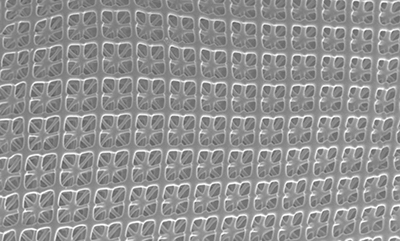
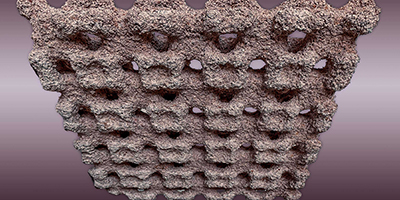
Nano-architected materials are made of tiny building blocks or repeating units measuring a few hundred nanometres in size – it would take more than 100 of them patterned in a row to reach the thickness of a human hair. These building blocks, which in this case are composed of carbon, are arranged in complex 3D structures called nanolattices.
To design their improved materials, Serles and Filleter worked with Professor Seunghwa Ryu and PhD student Jinwook Yeo at the Korea Advanced Institute of Science & Technology (KAIST) in Daejeon, South Korea. This partnership was initiated through the University of Toronto’s International Doctoral Clusters program, which supports doctoral training through research engagement with international collaborators.
The KAIST team employed the multi-objective Bayesian optimization machine learning algorithm. This algorithm learned from simulated geometries to predict the best possible geometries for enhancing stress distribution and improving the strength-to-weight ratio of nano-architected designs.
Serles then used a two-photon polymerization 3D printer housed in the Centre for Research and Application in Fluidic Technologies (CRAFT) to create prototypes for experimental validation. This technology enables 3D printing at the micro and nanoscale – creating optimized carbon nanolattices.
These optimized nanolattices more than doubled the strength of existing designs – withstanding stress of 2.03 megapascals for every cubic meter per kilogram of its density, which is about five times higher than titanium.
“This is the first time machine learning has been applied to optimize nano-architected materials, and we were shocked by the improvements,” said Serles. “It didn’t just replicate successful geometries from the training data; it learned from what changes to the shapes worked and what didn’t, enabling it to predict entirely new lattice geometries. Machine learning is normally very data-intensive, and it’s difficult to generate a lot of data when you’re using high-quality data from finite element analysis. But the multi-objective Bayesian optimization algorithm only needed 400 data points, whereas other algorithms might need 20,000 or more. So, we were able to work with a much smaller but an extremely high-quality data set.”
“We hope that these new material designs will eventually lead to ultra-lightweight components in aerospace applications, such as planes, helicopters, and spacecraft that can reduce fuel demands during flight while maintaining safety and performance,” said Filleter.
“This can ultimately help reduce the high carbon footprint of flying. For example, if you were to replace components made of titanium on a plane with this material, you would be looking at fuel savings of 80 liters per year for every kilogram of material you replace,” said Serles.
“Our next steps will focus on further improving the scale-up of these material designs to enable cost-effective macroscale components,” said Filleter. “In addition, we will continue to explore new designs that push the material architectures to even lower density while maintaining high strength and stiffness.”
For more information: Advanced Materials