Researchers at Stanford University have demonstrated that a new material may make phase-change memory—which relies on switching between high and low resistance states to create the ones and zeroes of computer data—an improved option for future AI and data-centric systems. Their scalable technology, as detailed in Nature Communications, is fast, low-power, stable, long-lasting, and can be fabricated at temperatures compatible with commercial manufacturing.
“We are not just improving on a single metric, such as endurance or speed; we are improving several metrics simultaneously,” said Eric Pop, the Pease-Ye Professor of electrical engineering and professor, by courtesy, of materials science and engineering at Stanford. “This is the most realistic, industry-friendly thing we’ve built in this sphere. I’d like to think of it as a step towards a universal memory.”
We task computers with processing ever-increasing amounts of data to speed up drug discovery, improve weather and climate predictions, train artificial intelligence, and much more. To keep up with this demand, we need faster, more energy-efficient computer memory than ever before.
Today’s computers store and process data in separate locations. Volatile memory—which is fast but disappears when your computer turns off—handles the processing, while nonvolatile memory—which isn’t as fast but can hold information without constant power input—takes care of the long-term data storage. Shifting information between these two locations can cause bottlenecks while the processor waits for large amounts of data to be retrieved.
“It takes a lot of energy to shuttle data back and forth, especially with today’s computing workloads,” said Xiangjin Wu, co-lead author on the paper and a doctoral candidate. “With this type of memory, we’re really hoping to bring the memory and processing closer together, ultimately into one device, so that it uses less energy and time.”
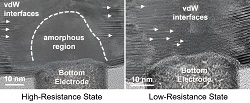
The memory relies on GST467, an alloy of four parts germanium, six parts antimony, and seven parts tellurium, which was developed by collaborators at the University of Maryland. Pop and his colleagues found ways to sandwich the alloy between several other nanometer-thin materials in a superlattice, a layered structure they’ve previously used to achieve good nonvolatile memory results.
This unique composition of GST467 gives it a particularly fast switching speed. Integrating it within the superlattice structure in nanoscale devices enables low switching energy, gives good endurance, very good stability, and makes it nonvolatile—it can retain its state for 10 years or longer.
There are many technical hurdles to achieving an effective, commercially viable universal memory capable of both long-term storage and fast, low-power processing without sacrificing other metrics, but the new phase change memory developed in Pop’s lab is as close as anyone has come so far with this technology. The researchers hope that it will inspire further development and adoption as a universal memory.
Image – Cross-sections of phase-change memory devices in the high- and low-resistance states. The diameter of the bottom electrode is ~40 nanometers. Arrows mark some of the van der Waals (vdW) interfaces which form between layers of the superlattice materials. The superlattice is disrupted and reformed between the high- and low-resistance states. Courtesy of: the Pop Lab.
For more information:
Stanford University