Rice University researchers have directly observed a superradiant phase transition (SRPT), a quantum phenomenon predicted over 50 years ago, which could revolutionize quantum computing, communication, and sensing. This occurs when quantum particles fluctuate collectively without external triggers, forming a new state of matter. The discovery was made in a crystal of erbium, iron, and oxygen, cooled to minus 457°F and exposed to a magnetic field of up to 7 tesla.
“Originally, the SRPT was proposed as arising from interactions between quantum vacuum fluctuations — quantum light fields naturally existing even in completely empty space — and matter fluctuations,” said Dasom Kim, a Rice doctoral student in the Applied Physics Graduate Program who is a lead author on the study. “However, in our work, we realized this transition by coupling two distinct magnetic subsystems — the spin fluctuations of iron ions and of erbium ions within the crystal.”
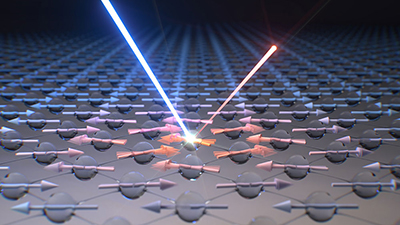
Spin describes the magnetic poles of electrons or other particles and can be envisioned as a tiny arrow attached to each particle, constantly twirling and pointing in a given direction. When spins align, they create magnetic patterns across a material. When the pattern of spins ripples across the material like a wave, the resulting collective excitation is known as a magnon.
Until now, whether or not an SRPT could actually take place was subject to debate as it runs against a limitation — called “no-go theorem” in theoretical physics — arising in light-based systems. By staging an SRPT in a magnetic crystal based on the interactions between two spin subsystems, the researchers were able to get around this barrier, creating a magnonic version of the phenomenon. Specifically, the iron ions’ magnons play the role traditionally attributed to vacuum fluctuations, and the erbium ions’ spins represent matter fluctuations.
Using advanced spectroscopic techniques, the researchers observed unmistakable signatures of an SRPT, with the energy signal of one spin mode vanishing and another showing a clear shift or kink. These spectral fingerprints match exactly what theory predicts for entering the superradiant phase, giving the team high confidence that they had indeed coaxed the long-sought state into being.
“We established an ultrastrong coupling between these two spin systems and successfully observed a SRPT, overcoming previous experimental constraints,” Kim said.
Researchers are excited not just because a 50-year-old physics prediction has been confirmed but also because of what this could mean for quantum technology. Collective quantum states at the SRPT have unique properties that could be harnessed for next-generation quantum technologies.
“Near the quantum critical point of this transition, the system naturally stabilizes quantum-squeezed states — where quantum noise is drastically reduced — greatly enhancing measurement precision,” Kim said. “Overall, this insight could revolutionize quantum sensors and computing technologies, significantly advancing their fidelity, sensitivity and performance.”
Sohail Dasgupta, a graduate student at Rice working with Kaden Hazzard, associate professor of physics and astronomy, theoretically modeled the SRPT, building on a model developed by their collaborator and co-author Motoaki Bamba, a professor at Yokohama National University.
“Although the basic mathematical model was already laid out before by Motoaki, we needed to account for some of the specific magnetic properties of the material to obtain the precise results. When your theory matches the experimental data ⎯ which happens rather rarely ⎯ it is the best feeling for a scientist,” Dasgupta said.
Hazzard said the achievement shows that concepts from quantum optics can be translated into solid materials.
“This opens a new way to create and control phases of matter using ideas from cavity quantum electrodynamics,” Hazzard said.
Moreover, the crystal used in this study is one example of a broader class of materials, which means the research paves the way for exploring quantum phenomena in other materials with similarly interacting magnetic components.
For more information: Science Advances
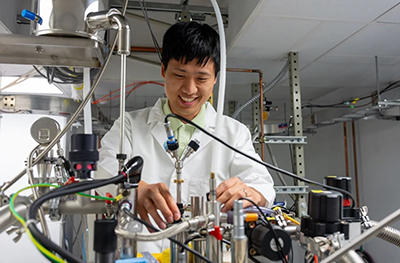
Image: Dasom Kim (Photo by Jorge Vidal/Rice University)