What do some high-end golf clubs and a living room window have in common? The answer is glass, but the golf clubs use metallic glass, which can be bent considerably and spring back into its original form. An international team of scientists hope their discoveries will lead to glass that can be both stronger and more ductile.
“We used an experimental technique called nanoindentation to repeatedly sample the initial formation of shear bands,” says Seth Imhoff at Los Alamos National Laboratory, N.M. “Essentially it uses a tiny needle to push on the surface of a sample in a very controlled way. Even though the force is small, the tip of the needle concentrates stress in one small region until a single shear band is generated in order to relieve some of that stress.”
By repeating this process many times scientists sample many local atomic arrangements and their specific critical stress levels. This evidence challenges the current assumption of only a single type of initiation site, or STZ (shear transformation zone). Identification of multiple types of STZs could lead to new opportunities for controlling the strength and ductility of bulk metallic glasses and, of course, more durable high-performance golf clubs.
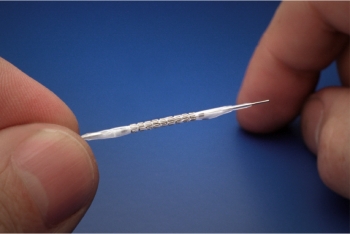
Image caption — A piece of metallic glass was bent around onto itself with a 1mm radius and glued into place. It would spring back to a flat piece if the glue were removed.