Researchers at Rice University, Houston, Texas, report that semiconducting phosphorus sheets do not contain the rows of defects that reduce the electronic properties of other materials. The researchers also show it may be possible to tune the electronic properties of 2-D phosphorus by altering (aka doping) it with foreign atoms. Carbon and zinc may boost positive conductivity, while potassium may increase negative conductivity; the researchers believe phosphorus may be a promising anode material for batteries.
Its stability makes 2D phosphorus a promising candidate for nano-electronic applications that require stable properties. Even when point defects or grain boundaries exist, the material’s semiconducting properties are stable. Like perfect graphene – but unlike imperfect graphene — it functions as expected.
In fact, 2-D phosphorus has more in common with three-dimensional silicon, the most common element in semiconducting electronics like computer chips. As in 2-D phosphorus, grain boundaries in silicon don’t cause band-gap changes. However, point defects in silicon can change its properties, unlike point defects in phosphorus.
This suggests 2-D phosphorus could also be a candidate for high-performance electronics. In fact, several experimental reports have already shown it can be a better transistor than 2-D metal dichalcogenides.
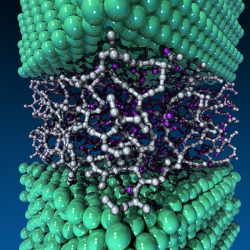
In a paper in the American Chemical Society journal Nano Letters (“Two-Dimensional Mono-Elemental Semiconductor with Electronically Inactive Defects: The Case of Phosphorus”), the Rice team analyzed the properties of elemental bonds between semiconducting phosphorus atoms in 2-D sheets. Two-dimensional phosphorus is not theoretical; it was recently created through exfoliation from black phosphorus.
The researchers noted that phosphorus is abundant and black phosphorus can be made relatively easily, but phosphorus reacts slowly with oxygen. To make it practical for daily applications, it has to be well-sealed.