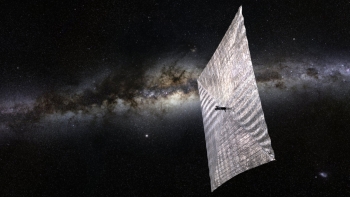
LightSail is a citizen-funded project by The Planetary Society, Pasadena, Calif. The company is sending two small spacecraft into Earth orbit carrying large, reflective sails measuring 32 m2 (344 ft2). Their first mission happens this month which will pave the way for a second, full-fledged solar sailing demonstration in 2016.
Solar sails use the sun’s energy as a method of propulsion—flight by light. Light is made of packets of energy called photons. While photons have no mass, a photon traveling as a packet of light has energy and momentum. Solar sail spacecraft capture light momentum with large, lightweight mirrored surfaces—sails. As light reflects off a sail, most of its momentum is transferred, pushing on the sail. The resulting acceleration is small, but continuous. Unlike chemical rockets that provide short bursts of thrust, solar sails thrust continuously and can reach higher speeds over time.
LightSail is a CubeSat. These tiny spacecraft often hitch rides to orbit aboard rockets carrying bigger payloads. CubeSats have standard unit sizes of 10 cm per side. They can be stacked together—LightSail is a three-unit CubeSat about the size of a loaf of bread. Once in space, LightSail’s solar arrays swing open, revealing the inside of the spacecraft. Four tape measure-like metal booms slowly unwind from storage, unfolding four triangular, Mylar sails. Each sail is just 4.5 μm thick.
Three electromagnetic torque rods aboard LightSail will interact with Earth’s magnetic field, orienting the spacecraft. Ground-based lasers will measure the effect of sunlight on the sails. As LightSail breezes around the Earth, its shiny sails will be visible from the ground. The first LightSail spacecraft will hitch a ride to orbit aboard an Atlas V rocket for a shakedown cruise. The spacecraft will not fly high enough above the Earth’s atmosphere for solar sailing, but the sail deployment sequence will be tested.
In 2016, LightSail will be enclosed within Prox-1, a small satellite developed by the Georgia Institute of Technology, Atlanta, to autonomously inspect other spacecraft. Both satellites will be lifted into orbit by the Falcon Heavy, a new heavy-lift rocket built by private spaceflight company SpaceX, Hawthorne, Calif. LightSail and Prox-1 will be released into an orbit with an altitude of 720 km (450 m), high enough to escape most of the planet’s atmospheric drag. Prox-1 will eject LightSail into open space. Later, it will rendezvous with LightSail and inspect it. When LightSail unfurls its solar sails, Prox-1 will be nearby to capture images of the big moment.
LightSail was built by Stellar Exploration Inc. The contractor for testing and flight readiness is Ecliptic Enterprises Corp. The spacecraft has ground stations at California Polytechnic State University (Cal Poly), San Louis Obispo, and Georgia Tech. Ground station testing occurs at Cal Poly. The project is managed by Doug Stetson, the founder and principal partner of the Space Science and Exploration Consulting Group. Boreal Space and Half-Band Technologies are contractors to Ecliptic.
Image caption — The LightSail solar sailing spacecraft is scheduled to ride a SpaceX Falcon Heavy rocket to orbit in 2016 with its parent satellite, Prox-1. Courtesy Josh Spradling/The Planetary Society.