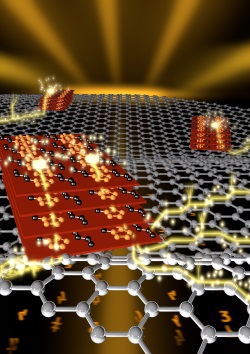
Researchers from Stanford University, Stanford, Calif., report that they have developed graphene sheathing material for the copper wires in computer chips. The graphene isolates the copper from the silicon on the chip, and also serve to conduct electricity. The isolating material — currently tantalum nitride — keeps the copper from migrating into the silicon transistors and rendering them non-functional. When the Stanford team used the thinnest possible layer of tantalum nitride they found that the industry standard was eight times thicker than the graphene layer that did the same work.
The Stanford experiment showed that graphene could perform this isolating role while also serving as an auxiliary conductor of electrons. Its lattice structure allows electrons to leap from carbon atom to carbon atom straight down the wire, while effectively containing the copper atoms within the copper wire.
These benefits — the thinness of the graphene layer and its dual role as isolator and auxiliary conductor — allow this new wire technology to carry more data between transistors, speeding up overall chip performance in the process.
In today’s chips the benefits are modest; a graphene isolator would boost wire speeds from 4% to 17%, depending on the length of the wire. however, as transistors and wires continue to shrink in size, the benefits of the ultrathin yet conductive graphene isolator become greater. The Stanford engineers estimate that their technology could increase wire speeds by 30% in the next two generations.
The Stanford researchers think the promise of faster computing will induce other researchers to get interested in wires, and help to overcome some of the hurdles needed to take this proof of principle into common practice. This would include techniques to grow graphene, especially growing it directly onto wires while chips are being mass-produced.