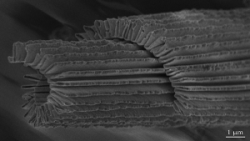
Researchers from North Carolina State University, Raleigh, report that they have fabricated stretchable transparent conductors that work because of their “nano-accordion” design. The researchers begin by creating a three-dimensional polymer template on a silicon substrate. The template is shaped like a series of identical, evenly spaced rectangles. The template is coated with a layer of aluminum-doped zinc oxide, which is the conducting material, and an elastic polymer is applied to the zinc oxide. The researchers then flip the whole thing over and remove the silicon and the template.
What’s left behind is a series of symmetrical, zinc oxide ridges on an elastic substrate. Because both zinc oxide and the polymer are clear, the structure is transparent. And it is stretchable because the ridges of zinc oxide allow the structure to expand and contract, like the bellows of an accordion.
“We can also control the thickness of the zinc oxide layer, and have done extensive testing with layers ranging from 30 to 70 nanometers thick,” says Erinn Dandley, a Ph.D. student in chemical and biomolecular engineering at NC State. “This is important because the thickness of the zinc oxide affects the structure’s optical, electrical and mechanical properties.”
The 3-D templates used in the process are precisely engineered, using nanolithography, because the dimensions of each ridge directly affect the structure’s stretchability. The taller each ridge is, the more stretchable the structure. This is because the structure stretches by having the two sides of a ridge bend away from each other at the base.
The structure can be stretched repeatedly without breaking. And while there is some loss of conductivity the first time the nano-accordion is stretched, additional stretching does not affect conductivity. Video of the conductor in action can be seen at https://youtu.be/Fl2uldbFYwc.
https://news.ncsu.edu/2015/06/chang-accordion-2015/