The Georgia Institute of Technology, Atlanta, and the Singapore University of Technology and Design (SUTD), report that researchers have demonstrated a four-dimensional printing technology that enables complex self-folding structures by using components made of smart shape-memory polymers with slightly different responses to heat.
The 3-D structures sequentially fold themselves from components that had been flat or rolled into a tube for shipment. The components could respond to stimuli such as temperature, moisture, or light in a way that can be precisely timed to create space structures, deployable medical devices, robots, and a range of other structures.
The researchers used smart shape memory polymers (SMPs) with the ability to remember one shape and change to another programmed shape when uniform heat is applied. The ability to create objects that change shape in a controlled sequence over time is enabled by printing multiple materials with different dynamic mechanical properties in prescribed patterns throughout the 3-D object. When these components are then heated, each SMP responds at a different rate to change its shape, depending on its own internal clock. By carefully timing these changes, 3-D objects can be programmed to self-assemble.
The research was reported September 8 in the journal Scientific Reports, which is published by Nature Publishing. The work is funded by the U.S. Air Force Office of Scientific Research, the U.S. National Science Foundation, and the Singapore National Research Foundation through the SUTD DManD Centre.
The research creates self-folding structures from 3-D printed patterns containing varying amounts of different smart shape-memory polymers. The patterning, done with a 3-D printer, allows the resulting flat components to have varying temporal response to the same stimuli. Earlier methods required application of differential heating at specific locations in the flat structure to stimulate the shape changes.
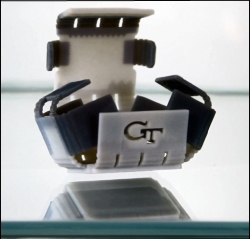
The team demonstrated the approach with a series of examples including a mechanism that can be switched from a flat strip into a locked configuration as one end controllably bends and threads itself through a keyhole. They also demonstrated a flat sheet that can fold itself into a 3-D box with interlocking flaps. These examples all require the precise control of the folding sequence of different parts of the structure to avoid collisions of the components during folding.
http://www.news.gatech.edu/2015/09/21/4-d-technology-allows-self-folding-complex-objects