Northwestern University, Evanston, Ill., reports that a new method of semiconductor characterization that is more accurate, efficient, and simple than existing methods has been developed by its researchers. The technology involves measuring electrical conductivity while applying a magnetic field to the semiconductor. The field is then flipped and the same measurements are taken. This allows determination of how uniform the electrical conductivity is across the entire semiconductor.
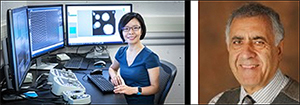
“We have figured out how to measure a single piece of material in a magnetic field while flipping the polarity to deduce the average variation in the density of electrons across the sample,” says Prof. Matthew Grayson of Northwestern’s McCormick School of Engineering and leader of the research team. The method works because the measurements taken at the edge of the sample can be used to determine any variations in conductivity throughout the sample. Grayson’s research team has created a new mathematical method that has made semiconductor characterization more efficient, more precise, and simpler. By flipping the magnetic field and repeating one measurement, the method can quantify whether or not electrical conductivity is uniform across the entire material – a quality required for high-performance semiconductors.
One of the main reasons that semiconductors are universally used in electronic devices is that their properties can be adjusted by doping with small amounts of gallium or arsenic. For doping to be effective, the impurities must be equally distributed throughout the semiconductor, as this ensures that every part of the semiconductor functions the same way. Prof. Grayson’s technique allows manufacturers to directly observe any non-uniformities that may be present.
The method can be used on a wide range of samples, from large 12-inch wafers to tiny 10-micron flakes. The method is particularly useful for the examination of 2D electronic materials such as graphene, which are so small that it is impossible for researchers to take multiple measurements at different locations on the surface.