Scientists at Penn State University, University Park, have reportedly discovered a way to incorporate vanadium dioxide thin films into transistors and memory devices to improve energy efficiency and robustness. Vanadium dioxide has the unusual property of metal-to-insulator transition, acting as a conductor at high temperatures and an insulator at low temperatures.
The metal-to-insulator property can ideally enhance state-of-the-art non-volatile memories by using the material as an augmentation device, which can also serve as a selector in some memory architecture.
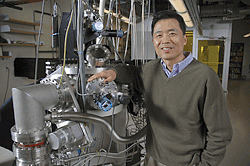
“It’s tough to replace current transistor technology because semiconductors do such a fantastic job,” said Roman Engel-Herbert, assistant professor of materials science and engineering. “But some materials, like vanadium oxide, can be added to existing devices to make them function even better.”
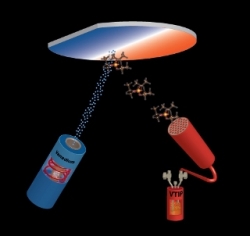
The researchers thought that if they could add vanadium oxide close to a device’s transistor it could boost the transistor’s performance. Also, by adding it to the memory cell, it could improve the stability and energy efficiency to read, write, and maintain the information state. The major challenge was to grow vanadium dioxide thin films on the wafer scale.
Vanadium dioxide, the targeted compound, looks simple, but it is very difficult to synthesize. In order to create a sharp metal-to-insulator transition, the ratio of vanadium to oxygen needs to be precisely controlled. When the ratio is exactly right, the material shows more than four orders-of-magnitude change in resistance, enough for a sufficiently strong on/off response.
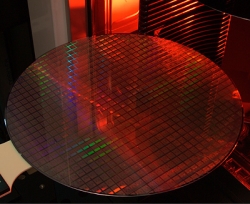
The Penn State team reports in the online journal Nature Communications that they are the first to achieve growth of thin films of vanadium dioxide on three-inch sapphire wafers with a perfect 1 to 2 ratio of vanadium to oxygen across the entire wafer.