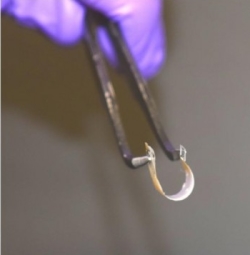
The University of California San Diego reports that its engineers have developed a thin, flexible, light-absorbing material that absorbs more than 87% of near-infrared light, with 98% absorption at 1550 nanometers, the wavelength for fiber optic communication.
A near-perfect broadband absorber, the material is capable of absorbing light from every angle. It also can theoretically be customized to absorb certain wavelengths of light while letting others pass through.
A team led by professors Zhaowei Liu and Donald Sirbuly at the UC San Diego Jacobs School of Engineering has created a nanoparticle-based broadband absorber that’s thin, flexible, and tunable. The work was published online on Jan. 24 in Proceedings of the National Academy of Sciences.
“This material offers broadband, yet selective absorption that could be tuned to distinct parts of the electromagnetic spectrum,” Prof. Liu said.
Researchers used a zinc oxide semiconductor, which has a moderate number of free electrons, and combined it with its metallic version, aluminum-doped zinc oxide, which houses a high number of free electrons — not as much as an actual metal, but enough to give it plasmonic properties in the infrared.
The materials were combined and structured in a precise fashion using advanced nanofabrication technologies in the Nano3 cleanroom facility at the Qualcomm Institute at UC San Diego. The materials were deposited one atomic layer at a time on a silicon substrate to create an array of standing nanotubes, each made of alternating concentric rings of zinc oxide and aluminum-doped zinc oxide. The tubes are 1730 nanometers tall, 650 to 770 nanometers in diameter, and spaced less than a hundred nanometers apart. The nanotube array was then transferred from the silicon substrate to a thin, elastic polymer. The result is a material that is thin, flexible, and transparent in the visible range.
http://jacobsschool.ucsd.edu/news/news_releases/release.sfe?id=2116