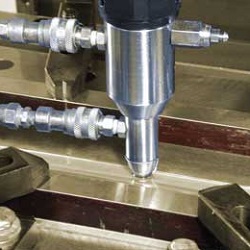
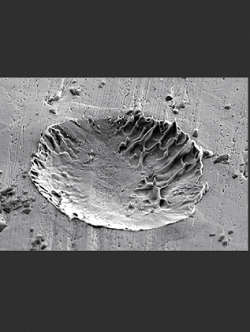
Lambda Technologies, Cincinnati, Ohio, reports that it has developed a surface treatment for modular orthopedic implants that completely eliminates the chance of failure from fretting fatigue. Low plasticity burnishing (LPB) develops a deep, beneficial surface layer of designed residual compression to mitigate fretting fatigue in titanium implants. The edge of contact region is put in high residual compression much deeper than the shallow shear cracks formed by fretting. Therefore, the cracks cannot propagate, and chance of fracture from fretting is eliminated.
Fatigue testing of the modular hip and knee prosthesis systems by original manufacturers showed that LPB treatment improves the baseline fatigue strength by nominally 40%, and completely eliminated the occurrence of fretting induced failure.
In the United States, the FDA has approved Lambda’s LPB process for extending the life of modular prostheses. During the twelve-plus years that orthopedic surgeons have been using LPB treated hip implants, and approximately three years of LPB treated knee implants, no LPB processed implant has failed from fretting fatigue.
“The cost savings and improvement in the quality of life for patients is immeasurable,” says Dr. N. Jayaraman, Director of Materials Research for Lambda Technologies. “And as an added bonus, the ease of implementation of LPB into existing production environments in CNC mills or lathes has made it very cost-effective for the manufacturers.”