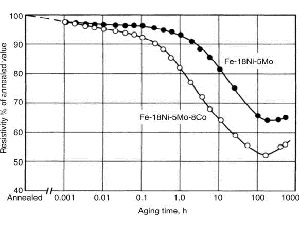
Electrical resistivity of maraging alloys decreases as the aging time increases, up to approximately 100 hours. The graph shows plots of electrical resistivity (percent of annealed value) versus aging time at 850°F for Fe-18Ni-5Mo and Fe-18Ni-5Mo-8Co maraging steels. It indicates cobalt/molybdenum interaction.
Because electrical resistivity is directly related to the amount of an alloy in solid solution, the electrical resistivity is influenced by the precipitation of compounds during aging. At aging times in excess of 100 hours, the electrical resistivity increases. A similar effect on hardness can be observed.
Aging times up to approximately 100 hours promote an increase in aged hardness in Fe-18Ni-5Mo-8Co and Fe-18Ni-5Mo maraging alloys, after which a decrease is observed. This phenomenon is known as austenite reversion, which accompanies the formation of equilibrium precipitates in overaged maraging steels.
Learn more here:
Volume 4D, Heat Treating of Irons and Steels -> Heat Treated High-Alloy Steels ->Heat Treating of Maraging Steels -> Martensite Aging