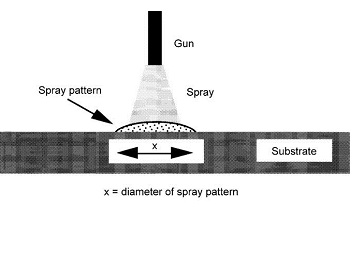
Thermal spraying is a line-of-sight process; therefore, the substrate coating area should preferably be normal (at 90 degrees) to the spray stream. The fundamental objective of torch and substrate motion during spraying is to present the target area to the spray stream in a steady, consistent, and repeatable manner, always maintaining the same torch-to-substrate spray angle, standoff (spray distance), and pitch or increment.
Manipulation is commonly done by moving the gun with an X–Y manipulator or robot. The part is often stationary, as with flat surfaces, or is rotated on a turntable or lathe, as in the case of cylinders. More complex components may require the use of coordinated motion between the robot and external axis of motion.
Controlled relative movement of the gun with respect to the part is critical for continuous and even deposition of the coating. Critical parameters are standoff distance, surface speed, angle of impingement, and pitch or increment.
Standoff distance is the distance between the face of the gun and the part or workpiece. This distance is critical because the optimal particle temperature and velocity occur in one plane along the length of the spray stream. Tolerance for standoff is a function of particle velocity. Higher-velocity processes are generally more tolerant of variation than the lower-velocity processes.
Using rules-of-thumb, pitch/increment values for HVOF and high-velocity plasma may range from 3 to 6 mm (0.13 to 0.25 in.), while flame and electric arc may be 6 to 12 mm (0.25 to 0.50 in.).
Volume 5A, Thermal Spray Technology -> Introduction to Coating Design and Processing -> Coating Deposition