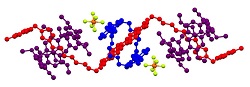
A recent paper by researchers at the University of Connecticut describes application of first-principles computational methods to analyze precipitate formation in age-hardenable aluminum alloys.
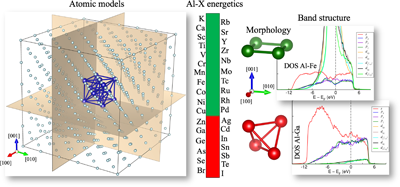
The key mechanism for age hardening metals and alloys is the obstruction of dislocation flow due to the presence of precipitates or secondary phases. The traditional explanation of precipitate morphologies is based on an overall energy minimization of interface energy and elastically stored energy. New insight points towards ground state bonding characteristics as controlling factors of precipitate morphologies. Therefore, strategies for designing custom alloys would benefit from understanding the energetics of the initial stages of these precipitates at the atomic level. Precipitates in age-hardenable aluminum alloys typically start off as Guinier-Preston zones (GPZs). In aluminum-copper (Al-Cu) and aluminum-silver (Al-Ag) binary alloys, the appearances of GPZs are distinctly different. In Al-Cu, these coherent particles have a plate-like morphology which form on (100) planes of Al. In Al-Ag, GPZs are more structurally isotropic and hence have a sphere-like appearance.
A group from the University of Connecticut (UConn) consisting of Cain Hung (PhD student in Materials Science and Engineering – MSE), post-doctoral research associate Dr. Sanjeev Nayak, and MSE Professors Rainer Hebert and Pamir Alpay have studied the initial stages of such GPZs, trying to explain why Cu and Ag, which are located in the same group of the periodic table, could form distinctly different GPZ morphologies in an aluminum matrix. After thousands of computations using first principles methods and density functional theory, an atomic-level explanation was found of precipitate morphologies that is based on the bonding characteristics of Cu and Ag with Al. Specifically, Dr. Nayak and Mr. Hung propose that an orbital hybridization controls the shape of clusters, something well-known in the field of nanomaterials. The researchers from UConn then expanded this analysis to other transition metals using similar computations. Drs. Hebert and Alpay state that these results could lead to the development of a new generation of precipitation hardenable aluminum alloys. The findings of this study were published in the article “Atomistic Origins of Guinier-Preston Zone Formation and Morphology in Al-Cu and Al-Ag Alloys from First Principles” in Scripta Materialia (Volume 162, 2019, p 235-240).
The University of Connecticut is one of the partners in the Center for Materials Processing Data (CMPD), which was launched in April 2018. The CMPD is industry-university partnership that generates and collects materials property data for use in manufacturing process models. Members have access to some of the best laboratory equipment in the world at the three partner universities: Worcester Polytechnic Institute, University of Connecticut, and University of Buffalo. A fourth partner, ASM International, offers access to the world’s largest metals-focused materials engineering community as well as additional data resources, and the latest information from the field of materials design and manufacturing.