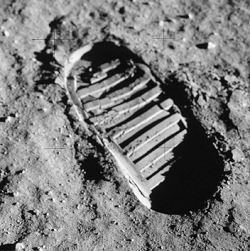
Zeiss, Oberkochen, Germany, reports that in October 1968, the company received the order for a camera lens to be used during the Moon landing, which was scheduled to take place a mere nine months later as part of the Apollo 11 mission.
“The time for development was extremely brief,” says Dr. Vladan Blahnik, who works in research and development at Zeiss. The optical data for the preceding model, the Biogon 4.5/38, still had to be calculated manually, an extremely time-consuming process. However, a mainframe computer helped to determine the mathematical parameters for the Biogon 5.6/60, the camera lens designed for the Moon landing, in only a couple of weeks. Dr. Erhard Glatzel (1925-2002), a leading mathematician from the optical design department, received the Apollo Achievement Award for this and the development of other special camera lenses for space photography.
The customized Zeiss Biogon 5.6/60 “Moon lens” had to meet a number of requirements. While it was supposed to work within an easy-to-use camera, it also had to precisely map the lunar surface around the landing site.
“They decided on a camera fitted with a Reseau plate, which created a grid of cross-marks on the images. These made it possible to calculate the distances between individual objects on the Moon,” explains Dr. Blahnik. “The special symmetric design of the camera lens provided an excellent correction for distortions and all other image errors.” A straight line remains a straight line. The images have great definition and edge-to-edge contrast.
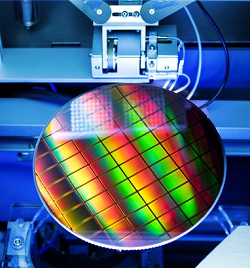
Apart from the Biogon used on the surface of the Moon, Zeiss designed a number of other special camera lenses for space photography in the 1960s, among them lenses that could transmit UV-waves, or extremely fast lenses such as the Planar 0.7/50. Engineers continue to benefit from this research until the present day. Some examples are the development of fast lenses for professional movie cameras, lenses for aerial photography used in surveying the Earth’s surface, and lithographic lenses employed in the production of microchips.
The camera lens was a small but significant contribution to the Apollo 11 lunar mission. And, the cameras with the Zeiss lenses are still up there on the Moon, because on the return journey the astronauts wanted to save every gram in order to take back as many samples of Moon rocks as possible. Only the valuable exposed film made it back to Earth.
https://www.zeiss.com/corporate/int/newsroom/press-releases.html?id=moon-landing_2019&%3fcpintpi1hp