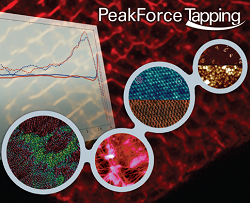
Bruker, Billerica, Mass., announces the ten-year anniversary of PeakForce Tapping, its proprietary atomic force microscopy mode that has been widely adopted in materials, data storage, and semiconductor research. It is outpacing all other recently developed AFM modes in research impact and productivity.
PeakForce Tapping and its associated modes ScanAsyst, PeakForce QNM, PeakForce TUNA, PeakForce KPFM, and PeakForce SECM, have been cited in more than 4,000 peer-reviewed publications over the last ten years, with over 30% of these publications in journals with impact factors in the top 10%.
This has led to one of PeakForce Tapping’s enabled modes, PeakForce Quantitative Nanomechanics (PeakForce QNM), being specifically cited in more than 2,000 publications. In energy research, PeakForce Tapping studies have resolved conductivity along individual lamellae in organic photovoltaics, revealed a nanocontact pinch-off that allows for improved solar fuel devices, and characterized the SEI layer in Li ion batteries in operando as well as ex situ. Battery work using the mode includes a recent Nature Communications article coauthored by Professor John Bannister Goodenough, the 2019 Chemistry Nobel Laureate for the development of Li ion batteries.
PeakForce Tapping permits the use of pN-level controlled imaging forces, increasing image resolution. Damaging lateral forces are eliminated, as is the spatial averaging inherent to TappingMode. In PeakForce Tapping, a complete force curve is acquired at every pixel, enabling nanomechanical mapping (with PeakForce QNM) that separates modulus from adhesion and provides quantitative data out of the box.
It also eliminates the need for contact mode in electrical modes, such as conductive and tunneling AFM (e.g., with PeakForce TUNA), enabling high resolution even on soft and fragile samples, and even in liquid (with PeakForce SECM). PeakForce Tapping is not subject to air damping, allowing for accurate tracking of high aspect ratio structures in industrial applications from nanometer roughness to deep trenches. With its linear feedback, it has an inherent control advantage over resonant modes, enabling robust self-optimization (with ScanAsyst) without requiring prior knowledge of the sample.