Oxford Instruments Asylum Research, Santa Barbara, Calif., has released an application note, “Characterizing Ferroelectric Response in Silicon-Doped Hafnium Oxide Thin Films.”
Hafnium oxide is one of the few binary oxides that is thermodynamically stable with silicon, and also can be used as a high-k dielectric material. Recently, engineers discovered that hafnium oxide could be deposited as a ferroelectric thin film by doping it with silicon and mechanically “capping” the film. This is a promising material for next-generation devices that take advantage of silicon/ferroelectric junctions such as ultra-fast, low-power ferroelectric transistors (FeFETS).
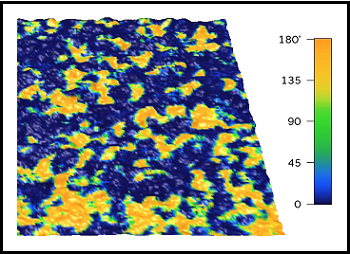
The new application note demonstrates how Asylum Research atomic force microscopes can be used to characterize ferroelectric hafnium oxide thin films using piezoelectric response force microscopy (PFM). Ferroelectric materials typically exhibit an extremely small piezoelectric response that can be difficult to measure with conventional PFM.
However, Asylum Research’s exclusive dual amplitude resonance tracking (DART) technology greatly increases the sensitivity of PFM measurements while avoiding measurement artifacts that are common in conventional PFM. This capability is unique to Asylum Research and available on all MFP-3D, Cypher, and Jupiter AFM models.
Image caption: This DART PFM phase image shows differently poled ferroelectric domains in a silicon-doped hafnium oxide thin film across a three-micron scan size.
For more information: https://afm.oxinst.com/Hf-oxide