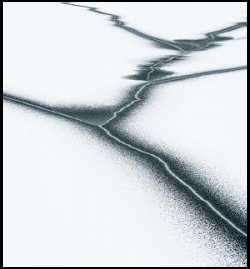
Researchers at the University of Illinois at Urbana-Champaign announce that they have developed a new calculation method that enables them to pinpoint the exact location and direction of a critical crack in a structure with a single analysis.
Calculating the energy release rate for the infinite potential locations and orientations of a surface crack in a 3D structure using conventional methods is an exhaustive task because a detailed analysis is needed for every crack location and orientation. However, this new method uses topological derivatives to get an estimate of what the energy release would be if a crack were to appear at any location and with any orientation along the surface of a 3D structure.
According to Philippe Geubelle, a professor in the Department of Aerospace Engineering, “This new method allows us to simplify the analysis tremendously, because instead of having to do an analysis for every single potential location of a crack along the surface, we perform a single analysis of the uncracked domain, which is much cheaper and faster to solve. This reduces the amount of computational work by orders of magnitude.
“Using this technique, we can immediately pinpoint the location and orientation that correspond to the highest energy release rate—meaning the highest energy available for crack propagation,” he says. “If the energy release rate is smaller than the fracture toughness, the crack won’t propagate. However, if the energy release rate approaches the value of the fracture toughness, then the structure will need a redesign.”
The new method can be combined with commercial finite element software packages such as Ansys, Abaqus, and Nastran.
The study, “Energy Release Rate Approximation for Small Surface Cracks in Three-Dimensional Domains Using the Topological Derivative,” was written by Kazem Alidoost, Meng Feng, Philippe H. Geubelle, and Daniel A. Tortorelli. It appears in the Journal of Applied Mechanics. DOI: 10.1115/1.4045793