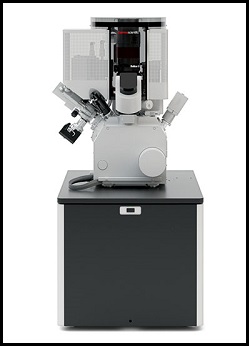
Engineers from Thermo Fisher Scientific discussed the voltage-contrast mechanism of a scanning electron microscope to probe electrical waveforms on FinFET transistors located within active integrated circuits, at the ASM International ISTFA 2019 conference in Portland, Oregon.
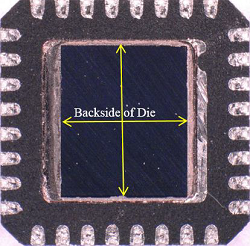
The FinFET devices are accessed from the backside of the integrated circuit, enabling electrical activity on any transistor within a working device to be probed. Gigahertz-bandwidth probing at 10-nm resolution using a stroboscopic pulsed electron source was demonstrated. In addition, sub-nanosecond temporal resolution along with sufficient spatial resolution to resolve FinFET transistors on the 14-nm node was achieved with a stroboscopic technique using a standard Helios G4 beam blanker on the SEM column.
The researchers also demonstrated an electrical-probing system bandwidth of 1.6 GHz from micron-sized metallic structures using sinusoidal beam blanking. The pulse-on-demand e-beam blanker that was used for the proof-of-concept data taken on FinFET transistors in a JTAG clock chain, showed rise times of 1.2 ns.
However, using the same pulse-on-demand setup, they observed a rise time of approximately 500 ps from a copper microstrip transmission line, suggesting the system is capable of GHz performance, and we therefore suspect the reduced-bandwidth edges observed on the JTAG clock were likely limited by our test setup and not by any system measurement limitation.
We continue to learn how this tool operates, and we acknowledge that a more custom SEM configuration could be designed with high-speed e-beam probing in mind. Nevertheless, this standard Helios tool enables analysis of circuit activity through voltage contrast measurements with GHz measurement capability. This is a giant leap in the spatial resolution from optical failure analysis methods that have approximately 160-nm resolution.
This work paves a path for transistor-level analysis on FinFET circuits. By further optimizing the system and blanker design, higher temporal resolution may be achieved. A dedicated high-speed beam blanker such as the one described in Meuret et al. should allow us to probe DUT signals at 8-GHz speeds, though this is currently untested.
Failure analysis of FinFET circuitry at GHz speeds using voltage-contrast and stroboscopic techniques on a scanning electron microscope
James Vickers, Seema Somani, Blake Freeman, Thermo Fisher Scientific, Fremont, California
Pete Carleson, Thermo Fisher Scientific, Hillsboro, Oregon
Lubomír Tůma, Marek Unčovský, Petr Hlavenka, Thermo Fisher Scientific, Czech Republic