The forge quenching process requires that quenching equipment be placed as closely as possible to the equipment used in the forging stage. Since the early 1960s, various direct-forge and quench equipment has been installed in this manner, thus enabling the use of carbon steels, which have good hardenability from grain growth and high dislocation density from the thermomechanical deformation performed during hot forging.
In these processes, the blank or forged parts are transferred to a connected quench tank piece by piece on a conveyor or some other mechanism. During the transfer, the temperature of the forged blanks is controlled, and they are then directly quenched into oil or aqueous solution. After removal from the quench tank, the blanks are transferred to the tempering furnace. The equipment for this transfer must be designed to accommodate a wide range of forged blank materials and shapes, along with many other metallurgical considerations. The various unique mechanisms available include rotary holding, vertical and hanger conveyors, and other transport methods.
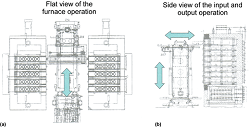
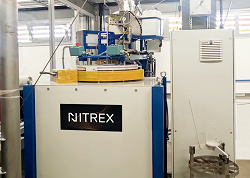
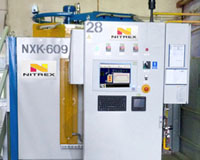
Depending on the necessary temperature conditions, various conveyor and holding furnaces have been developed, including the flat table, notched beam, and hanger conveyor furnace (Ref 45), and piece-by-piece controlled cooling equipment. This new direct isothermal annealing (IA) furnace has been developed to improve quality and reduce processing costs.
For more information, click on the link below (subscription required). Then scroll to Figure 28.
H. Tahira, K. Funatani, Forge and Direct Heat Treatment Processes and Technologies, Heat Treating of Irons and Steels, Vol 4D, ASM Handbook, Edited By Jon L. Dossett, George E. Totten, ASM International, 2014, p 241-252, https://doi.org/10.31399/asm.hb.v04d.a0005994