Powder metallurgy (PM) processes include press and sinter hardening, metal injection molding, powder forging, hot isostatic pressing, powder rolling, and spray forming. Press and sintering is the PM process most commonly encountered by heat treaters.
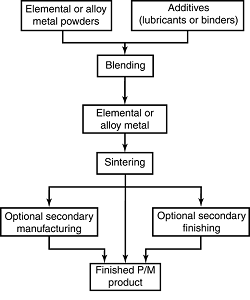
Parts that have two-dimensional complexity, but have a limited number of flat surfaces in the third dimension, are especially suitable to be produced using this method. For example, a power-transmission gear is an ideal part to be made by press and sinter with its complicated outline, but simple shape along the axis of the gear. The most important attribute of a press and sinter part is its dimensions. If the dimensions of each part can be controlled, press and sintering is a very cost-effective way to make metallic parts. The general steps in the press and sinter process are shown in the figure.
Compaction is probably the most critical step in the PM process because it sets both the density of the powder and density uniformity throughout the product. It is also where almost all of the shaping of the part occurs. The objective of compaction is to produce a high-density compact with sufficient green strength for in-process handling and transport to the sintering furnace. Because final properties strongly depend on density, uniform properties require uniform density.
For more information, click on the link below (subscription required). Then scroll to Figure 1.
Joseph W. Newkirk, Heat Treatment of Powder Metallurgy Steels, Heat Treating of Irons and Steels, Vol 4D, ASM Handbook, Edited By Jon L. Dossett, George E. Totten, ASM International, 2014, p 253-273, https://doi.org/10.31399/asm.hb.v04d.9781627081689.